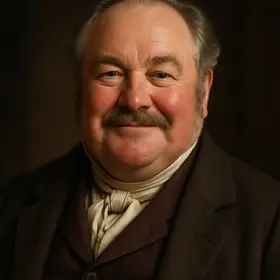
Mr. Bulstrode in Middlemarch
Major character
A wealthy, respectable banker whose past and private actions complicate public philanthropy and professional reform in Middlemarch.
Who is Mr. Bulstrode?
Mr. Bulstrode appears as a prosperous, influential donor whose money helps civic projects such as the New Hospital. He wants social respectability and to shape Middlemarch’s institutions, but his unpopularity and a concealed past cast suspicion on his motives. He provides funds that become entangled with Tertius Lydgate’s medical reform scheme, and his involvement provokes professional opposition to the Hospital. When the shabby, delirious John Raffles produces a paper linked to Bulstrode, the strand of secrecy begins to unravel: Caleb Garth refuses to serve him further after learning enough to trouble his conscience, and Bulstrode reacts with fear and self-protective movements—sending for doctors, watching Raffles, and weighing departure from town. Across the chapters he oscillates between public benefactor and a figure whose hidden liabilities threaten the causes he supports.
Personality
- Influential
- He is the main supporter of the proposed New Hospital and his patronage shapes local medical politics (Chapter 44).
- Secretive
- A letter signed by Nicholas Bulstrode is found by Raffles and carried off, suggesting concealed papers and private histories (Chapter 41).
- Fearful
- On learning Raffles is sick at Stone Court he is alarmed, conceals his fear, and goes there himself to discover what was said (Chapter 69).
- Self-protective
- After Caleb refuses to be his agent, Bulstrode arranges medical attendance at Stone Court and contemplates leaving Middlemarch (Chapters 69, 76).
- Controversial
- Lydgate attributes local opposition to the Hospital chiefly to Bulstrode’s personal unpopularity and professional feuds (Chapter 44).
Character arc
When first encountered in these chapters, Bulstrode is the wealthy mover behind philanthropic projects—the sort of man whose money can make a hospital possible and whose name carries weight in Middlemarch. That public role, however, coexists with secretive priorities: a compromising letter bearing his signature and the appearance of John Raffles as a potentially dangerous witness introduce a private past that threatens his standing. Caleb Garth’s moral refusal to continue as his agent marks a turning point: Bulstrode’s business relations begin to unravel as conscience and gossip intrude. He reacts to the immediate crisis with alarm and maneuvering—sending for Lydgate, attending to Raffles at Stone Court, and considering withdrawal from town—showing a man more intent on containing scandal than addressing its moral implications. By the later chapters he is driven from the safe space of public benefaction into defensive isolation, his influence undermined by the very secrecy that had protected him.
Relationships
- Tertius Lydgate Bulstrode is a donor whose money and reputation deeply affect Lydgate’s Hospital scheme; Lydgate’s professional peril becomes entangled with Bulstrode’s reputation.
- Mrs. Bulstrode She desires a painting at the Larcher sale and Bulstrode acts for her, showing domestic ties that surface in public events (Chapter 60).
- Caleb Garth Caleb serves as Bulstrode’s agent until he learns something from Raffles that makes him resign on grounds of conscience (Chapter 69).
- John Raffles Raffles carries a scrap of paper signed by Bulstrode and, when ill, becomes a focal point of Bulstrode’s fear that past secrets will be revealed (Chapters 41, 69).
- Dorothea Brooke Dorothea defends Lydgate’s cause against the suspicion associated with Bulstrode and mobilizes aid that counters Bulstrode-related opposition (Chapters 44, 76).
- Will Ladislaw Will is asked by Bulstrode to judge a painting for Mrs. Bulstrode at the Larcher sale; the same event brings Raffles into contact with Will (Chapter 60).
Quotes by Mr. Bulstrode
“many a man has been left hanging because there was no knife to cut him down. Gentlemen, here’s a fender that if you had the misfortune to hang yourselves would cut you down in no time—with astonishing celerity—four-and-sixpence—five—five-and-sixpence—an appropriate thing for a spare bedroom where there was a four-poster and a guest a little out of his mind—six shillings—thank you, Mr. Clintup—goin”
Chapter 60Trumbull uses a grotesque, joking sales-patter about a fender to excite bidding and amuse (and embarrass) the auction audience, revealing his rhetorical flair and the sale’s comic atmosphere.
Why Mr. Bulstrode matters
Bulstrode embodies the novel’s interrogation of respectability, public philanthropy, and hidden moral jeopardy. His patronage shows how money can enable reform but also how personal history and secrecy can taint public goods. The chapters link his influence to broader themes: conscience (Caleb’s refusal), the fragility of reputation (Raffles’ paper), and the limits of charitable acts when not matched by moral transparency. Bulstrode’s predicament forces other characters—Lydgate, Dorothea, and the town—to confront whether social improvement can be disentangled from the private faults of its patrons.
Chapters with Mr. Bulstrode
More Middlemarch characters
 Dorothea BrookeProtagonist
 Tertius LydgateMajor character
 Will LadislawMajor character
 Mr. BrookeMajor character
 Sir James ChettamMajor character
 Rosamond VincyMajor character
 Nicholas BulstrodeMajor character
 Mr. VincyMajor character
All chapter summaries ›Characters ›
Read Middlemarch illustrated
Every scene in these notes comes from the Book2Life reader, where the full public-domain text is illustrated as you read, with character portraits and narration. Free in your browser and on iPhone.
