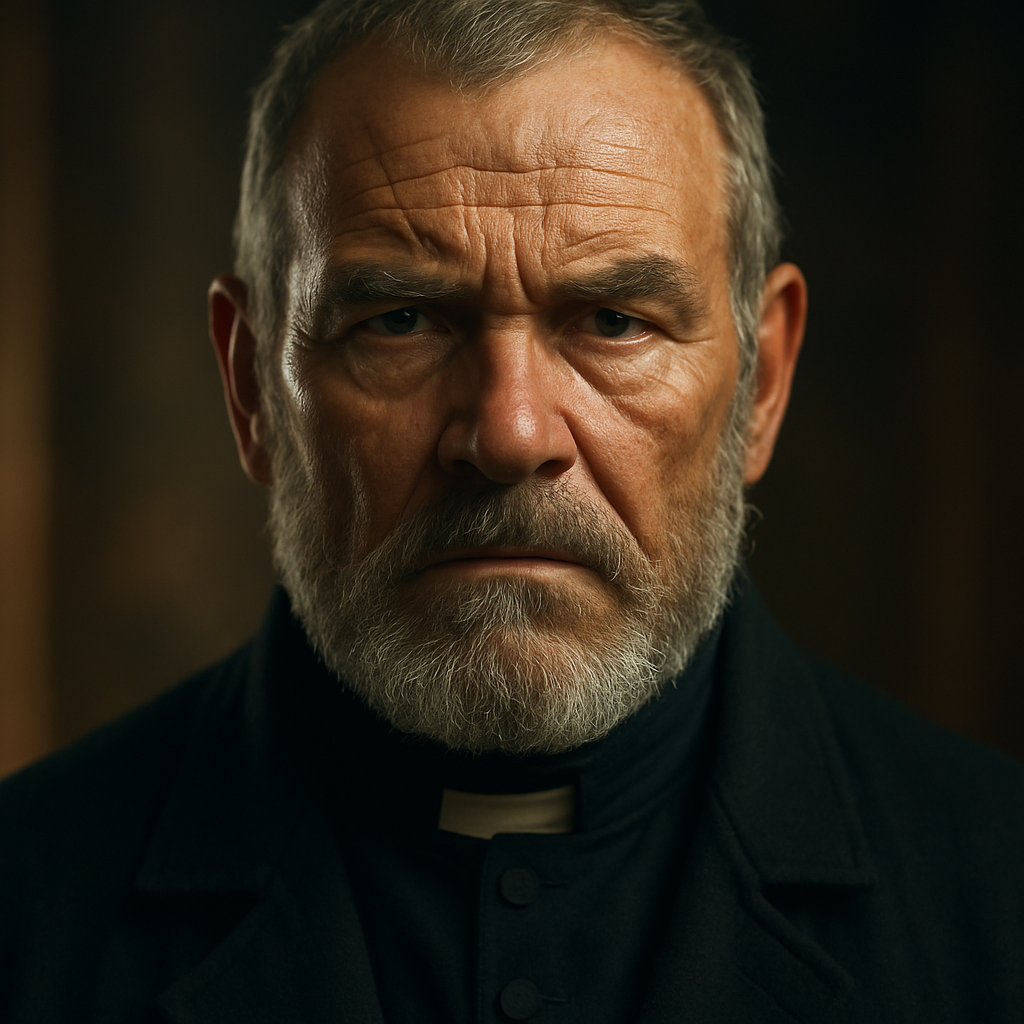
Father Mapple in Moby-Dick
Major character
Venerable, sea-seasoned chapel preacher who delivers a thunderous sermon on Jonah to a whalemen’s congregation.
Who is Father Mapple?
Father Mapple is the revered chaplain of the Whalemen’s Chapel in New Bedford, introduced as a soaked, robust old sailor who mounts a ship-like pulpit. He wants to instruct and morally orient the seafaring community, binding maritime life to biblical lessons. In the pulpit he dramatizes Jonah’s flight, punishment, and repentance and then exhorts his listeners to humility, conscience, and the duty of prophetic truth. His sermon underscores accepting punishment and steadfastness in truth rather than pursuing comfort or reputation. Through ritual, nautical symbolism, and a forceful homily, Mapple defines the congregation’s spiritual bearings, sets an ethical standard for whalemen, and frames the novel’s moral and spiritual stakes before the Pequod sails.
In the book: Father Mapple is the revered preacher of the Whalemen’s Chapel in New Bedford, a former sailor whose pulpit and sermon fuse maritime life with biblical parable. His thunderous homily on Jonah exhorts humility, conscience, and obedience, setting the novel’s moral and spiritual compass. Through him, the narrative establishes the seafaring community’s rituals and foreshadows the epic struggles between human will, faith, and the vast, inscrutable sea.
Personality
- authoritative
- He mounts a shiplike pulpit above the congregation and delivers a commanding sermon that rivets the whalemen’s attention.
- maritime-minded
- His pulpit is rigged like a ship’s prow with a rope ladder and ship-paneling, and his sermon constantly frames Jonah in nautical terms.
- moralistic
- He insists that Jonah’s repentance in the whale teaches acceptance of punishment and warns against escaping one’s divine duty.
- dramatic
- He physically hauls up the ladder to isolate himself in the pulpit and uses a vivid sermon narrative to move the congregation.
Character arc
Mapple’s dramatic entrance establishes him immediately as a figure of ritual and authority: drenched by sleet, he strips off outerwear, ascends a shiplike pulpit by a rope ladder, and positions himself above the congregation, enacting the maritime-sacred fusion he embodies. In the sermon he reconstructs Jonah’s voyage and conscience, first narrating the prophet’s flight, the sailors’ casting of lots, and Jonah’s consenting to be thrown overboard, then pivoting to the preacher’s principal lesson—prophetic duty, accepting punishment, and the peril of seeking comfort or reputation over truth. He never undergoes a personal transformation; rather, his role is to set moral direction for others. After kneeling in benediction, he leaves the congregation charged with his exhortation. From first sight to last he remains the steady, salt-seasoned moral voice: ritualistic, uncompromising, and emblematic rather than personally transformed.
Relationships
- Ishmael Ishmael observes and interprets Mapple’s pulpit, describing his appearance, actions, and symbolic staging for the reader.
- Queequeg Queequeg, present in the audience, is part of the whalemen’s congregation whom Mapple addresses with his maritime sermonizing.
- Bildad Bildad, one of the ship-owners who later appears in chapter notes, represents the pious, chiding strand of whalemen’s religion that Mapple’s sermon complements.
- Peleg Peleg, another shipowner and practical seaman, contrasts with Mapple’s moralizing but shares the same whalemen community that Mapple ministers to.
- Jonah Jonah is the biblical subject of Mapple’s sermon: Mapple re-narrates Jonah’s flight, punishment, and repentance to teach obedience and conscience.
Quotes by Father Mapple
““Shipmates, this book, containing only four chapters—four yarns—is one of the smallest strands in the mighty cable of the Scriptures.””
Chapter 9Mapple situates the brief Book of Jonah within the larger authority of Scripture and addresses his seafaring audience directly.
““Woe to him who seeks to pour oil upon the waters when God has brewed them into a gale! Woe to him who seeks to please rather than to appal!””
Chapter 9Mapple issues a moral indictment against those who avoid unpleasant truth to keep favor or peace, framing prophetic duty as confrontational.
““Delight is to him, who gives no quarter in the truth, and kills, burns, and destroys all sin though he pluck it out from under the robes of Senators and Judges.””
Chapter 9He promises a transcendent reward for those who uphold divine truth uncompromisingly, even against powerful institutions.
Why Father Mapple matters
Father Mapple functions as the novel’s moral and spiritual compass at the moment the Pequod and its crew are about to be gathered. By fusing nautical ritual with biblical parable, he frames key themes—conscience, obedience, the acceptance of punishment, and the cost of prophetic truth—while also staging the sea as a place of moral testing. His sermon foreshadows the novel’s central conflicts between human will and inscrutable forces, and his pulpit’s shiplike design literalizes the book’s recurring metaphor of the world as a vessel beset by storms.
Chapters with Father Mapple
More Moby-Dick characters
 Ahab
Ahab Ishmael
 Stubb
Stubb Queequeg
 Starbuck
 Flask
Flask Tashtego
 Moby Dick
All chapter summaries ›Characters ›
Read Moby-Dick illustrated
Every scene in these notes comes from the Book2Life reader, where the full public-domain text is illustrated as you read, with character portraits and narration. Free in your browser and on iPhone.
