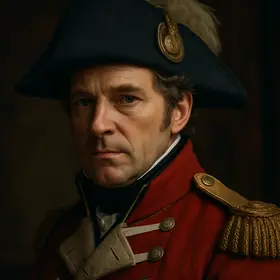
Colonel Fitzwilliam in Pride and Prejudice
Minor character
A friendly, easy-mannered officer and cousin to Mr. Darcy who visits Rosings and chats freely with Elizabeth.
Who is Colonel Fitzwilliam?
Colonel Fitzwilliam appears as an affable, sociable officer who accompanies Mr. Darcy to Rosings and frequently calls at the Collinses' parsonage. He enjoys conversation and puts Elizabeth at ease with animated talk about travel, books, music, and local habits, making him a pleasant contrast to Darcy's reserve. While mainly social, he also supplies important information: in casual conversation he hints that Darcy once prevented an imprudent marriage, and Darcy later cites him as a corroborating witness in his explanatory letter to Elizabeth. Fitzwilliam therefore functions both as an agreeable companion within the Rosings circle and as a source whose remarks prompt Elizabeth to reassess Darcy's interference in Jane and Bingley's relationship. He does not dominate events but his openness and willingness to converse advance Elizabeth's understanding of Darcy and contribute to the novel's revelations.
Personality
- affable
- At Rosings he 'proves friendly and easy in manner' and seats himself beside Elizabeth to carry on animated conversation (Ch. 30–31).
- sociable
- He frequents the Parsonage because he 'enjoys their company' and entertains Elizabeth with talk of Kent, Hertfordshire, travel, books, and music (Ch. 31, 32).
- observant
- In a park conversation he mentions that Darcy once 'saved a friend from an imprudent marriage,' prompting Elizabeth to suspect Darcy's role in separating Jane and Bingley (Ch. 33).
- candid
- His willingness to speak about delicate matters in casual talk gives Elizabeth key information she did not previously have (Ch. 33).
- credible witness
- Darcy invokes Colonel Fitzwilliam as a corroborating witness when explaining Wickham's conduct and his own actions in a letter to Elizabeth (Ch. 35).
Character arc
Colonel Fitzwilliam's presence remains steady and consistent from his first call at the parsonage through his departure from Rosings. He enters as an easy companion—pleasant, talkative, and attentive to social exchange—providing Elizabeth with an immediate contrast to Darcy's reserve. Midway through his appearances he shifts from simply entertaining to revealing: a casual remark in the park about Darcy's intervention in an imprudent marriage plants the seed of suspicion in Elizabeth that Darcy played a part in separating Jane and Bingley. That disclosure subtly alters the course of Elizabeth's inquiries and feelings, as Darcy later names him to support the account in his letter. Fitzwilliam himself does not undergo a moral or emotional transformation; he remains a candid, sociable officer whose principal narrative function is to inform and humanize the Rosings circle and to catalyze Elizabeth's reassessment of Darcy and the events affecting her family. By the time he departs, he has helped move Elizabeth from amused interest to serious reflection without changing fundamentally himself.
Relationships
- Mr. Darcy Cousin and companion; he accompanies Darcy to Rosings and is later cited by Darcy as a corroborating witness (Ch. 30, 35).
- Elizabeth Bennet Conversational companion and source of information; he sits with her at Rosings and supplies remarks that prompt her suspicions about Darcy (Ch. 31, 33).
- Lady Catherine de Bourgh Family connection through Darcy; he appears as one of the young men frequenting Rosings under her oversight (Ch. 31, 37).
- Mr. Bingley Indirectly connected through discussion of an imprudent marriage that Darcy once prevented—a remark that implicates Bingley's broken attachment to Jane (Ch. 33).
- Charlotte Lucas (Mrs. Collins) Regular visitor acquaintance; he frequently calls at the Parsonage and enjoys the company of Charlotte and the Collins household (Ch. 31–32).
- Georgiana Darcy Kinswoman by association through Darcy and present in the Rosings household conversations where Fitzwilliam's easy manners contrast with family formality (Ch. 31).
Quotes by Colonel Fitzwilliam
““We were talking of music, madam,” said he, when no longer able to avoid a reply.”
Chapter 31He answers Lady Catherine’s demand to know the subject of conversation, introducing the musical theme of the scene.
“There were some very strong objections against the lady,”
Chapter 33Fitzwilliam hints that Darcy had reasons—unspecified and sensitive—for preventing a marriage, prompting Elizabeth's suspicion that it concerned Jane.
Why Colonel Fitzwilliam matters
Colonel Fitzwilliam functions as a social foil and narrative prompt: his easy civility highlights Darcy's stiffness and offers Elizabeth a more immediately pleasant male acquaintance, which sharpens her contrasts and judgments. More crucially, his offhand disclosures provide factual leads that destabilize Elizabeth's assumptions and push the plot toward revelation—especially regarding Darcy's interference in Jane and Bingley's relationship. As a credible, talkative figure invoked by Darcy himself, Fitzwilliam helps the novel explore themes of pride versus openness, the reliability of testimony, and how casual remarks within social life can reshape reputations and relationships.
Chapters with Colonel Fitzwilliam
More Pride and Prejudice characters
 Elizabeth BennetProtagonist
 Jane BennetMajor character
 Mr. BingleyMajor character
 Mr. DarcyMajor character
 Mrs. BennetMajor character
 Mr. BennetMajor character
 Lydia BennetMinor character
 Mr. CollinsMajor character
All chapter summaries ›Characters ›
Read Pride and Prejudice illustrated
Every scene in these notes comes from the Book2Life reader, where the full public-domain text is illustrated as you read, with character portraits and narration. Free in your browser and on iPhone.
