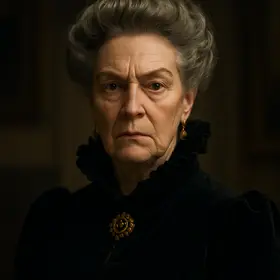
Lady Catherine de Bourgh in Pride and Prejudice
Antagonist
A wealthy, domineering aristocrat who presides at Rosings Park and enforces social hierarchy and propriety.
Who is Lady Catherine de Bourgh?
Lady Catherine de Bourgh is the imperious patroness of Mr. Collins and the mistress of Rosings Park; she supervises local affairs and the upbringing of her sickly daughter, Anne de Bourgh. She uses her rank to lecture, inspect, and dictate manners, household arrangements, and the prospects of those around her. Throughout the chapters she receives visits from the Lucases and the Collinses, inspects the parsonage and its inmates, and interrogates Elizabeth Bennet about her family and education. When a rumor links Elizabeth to her nephew Mr. Darcy, Lady Catherine travels unannounced to Longbourn to suppress it, confronting Elizabeth and attempting to secure a pledge that Elizabeth will never accept Darcy. Her efforts fail, and she leaves angrily. After Darcy’s engagement and subsequent marriage to Elizabeth, Lady Catherine initially reacts with violent disapproval and severs correspondence, but the notes record that she later reconciles enough to visit. Her presence drives confrontations that reveal characters’ principles and catalyze shifts in Darcy and Elizabeth’s relationship.
In the book: Lady Catherine de Bourgh is the wealthy, domineering mistress of Rosings Park, aunt to Fitzwilliam Darcy and mother to the sickly Anne de Bourgh. She embodies entrenched aristocratic privilege and social rigidity, using her status to dictate manners, marriages, and conversation. Her encounters with Elizabeth Bennet highlight themes of class, independence, and moral courage, and her attempts to manage others become a key force that tests—and reveals—the characters’ principles.
Personality
- Domineering
- At Rosings she lectures visitors, interrogates Elizabeth on family and education, and prescribes domestic arrangements to Charlotte (Chapter 29, 31).
- Aristocratic
- Her rank and patronage of Mr. Collins are repeatedly emphasized—Collins continuously flatters her and credits her civility as his exemplar (Chapters 13–15, 30).
- Prescriptive
- She insists upon dictating who is proper for her nephew to marry and demands Elizabeth promise never to accept Darcy (Chapter 56).
- Protective of family interest
- She travels to Longbourn specifically to oppose any match between Darcy and Elizabeth, invoking family honour and designs for her daughter (Chapter 56).
- Proud but mutable
- After initially cutting off correspondence in anger at Darcy’s marriage, she eventually permits reconciliation and later visits (Chapter 61).
Character arc
Lady Catherine enters as an entrenched figure of aristocratic authority: exacting, officious, and confident that her rank gives her a right to control others’ choices. At Rosings she presides over visitors, inspects domestic arrangements, and corrects behaviour; her patronage shapes Mr. Collins’s servility and local deference (Chapters 29–31). Her power feels unassailable when she marches to Longbourn to quash a rumour of a match between Darcy and Elizabeth, attempting to extract a pledge that Elizabeth will never accept Darcy (Chapter 56). That confrontation exposes her assumptions about birth, status, and influence, but Elizabeth refuses to be cowed. Lady Catherine departs in anger, and her attempt to dictate private decisions fails (Chapter 56–57). The later narrative records her initial violent disapproval of Darcy’s eventual marriage and a temporary rupture in correspondence (Chapter 61). Yet by the end she softens enough to reconcile and even visit, suggesting a limited retreat from absolute opposition and implying that her authority, though still present, yields to family resolutions and social realities (Chapter 61).
Relationships
- Fitzwilliam Darcy Her wealthy nephew whose romantic choices she seeks to control and whose conduct she expects to reflect family designs (Chapters 31, 56, 58, 61).
- Anne de Bourgh Her frail, sickly daughter, presented as the intended match and focus of Lady Catherine’s household concern (Chapters 13–15, 29).
- Mr. Collins Her obsequious clergyman and dependent; he constantly praises her and models his deference on her favour and patronage (Chapters 13–15, 28–30).
- Elizabeth Bennet A verbal foil: Elizabeth resists Lady Catherine’s imperious intrusions and refuses to be intimidated when confronted about Darcy (Chapters 29, 31, 56).
- Charlotte Lucas (Mrs. Collins) A neighbour and hostess at the parsonage whose domestic accommodation of Collins puts her under Lady Catherine’s approving scrutiny (Chapters 28–30).
- Colonel Fitzwilliam One of the young men who visits Rosings and the parsonage; his sociability contrasts with Lady Catherine’s severity though she regards the household as her sphere (Chapters 31, 37).
Quotes by Lady Catherine de Bourgh
“'Lady Catherine,' said she, 'you have given me a treasure.'”
Chapter 29Anecdote cited by Lady Catherine about placing a young person and being praised for it, showing her self-satisfaction in matchmaking and patronage.
“Your father's estate is entailed on Mr. Collins, I think?”
Chapter 29Lady Catherine probes the Bennet family’s situation and property, revealing her concern with inheritance and social order.
““I have told Miss Bennet several times, that she will never play really well, unless she practises more; and though Mrs. Collins has no instrument, she is very welcome, as I have often told her, to come to Rosings every day, and play on the pianoforte in Mrs. Jenkinson’s room.””
Chapter 31Lady Catherine asserts authority over musical taste and offers patronizing advice while proposing Rosings as an instructional refuge.
“I am excessively attentive to all those things.”
Chapter 37Lady Catherine asserts her fastidiousness about proper appearances and how young women ought to travel and be accompanied.
“You can be at no loss, Miss Bennet, to understand the reason of my journey hither. Your own heart, your own conscience, must tell you why I come.”
Chapter 56Lady Catherine begins the confrontation by asserting she knows why she has come and expecting Elizabeth to confess to a connection with Mr. Darcy.
“I take no leave of you, Miss Bennet. I send no compliments to your mother. You deserve no such attention. I am most seriously displeased.”
Chapter 56Lady Catherine departs in a huff after failing to secure the assurance she demanded, underlining her offended pride and the social breach between them.
Why Lady Catherine de Bourgh matters
Lady Catherine embodies the novel’s critique of rigid class privilege and social authority: her interventions expose assumptions about birth, marriage, and propriety. By attempting to dictate an individual’s marriage and by publicly policing behaviour, she provokes moral resistance—most notably in Elizabeth—thereby foregrounding themes of personal integrity, autonomy, and the limits of aristocratic power. Her eventual partial reconciliation also shows that social hierarchies can be negotiated rather than absolute, and her presence helps reveal Darcy’s obligations between family duty and personal feeling, making her a catalyst for the novel’s central transformations.
Chapters with Lady Catherine de Bourgh
More Pride and Prejudice characters
 Elizabeth BennetProtagonist
 Jane BennetMajor character
 Mr. BingleyMajor character
 Mr. DarcyMajor character
 Mrs. BennetMajor character
 Mr. BennetMajor character
 Lydia BennetMinor character
 Mr. CollinsMajor character
All chapter summaries ›Characters ›
Read Pride and Prejudice illustrated
Every scene in these notes comes from the Book2Life reader, where the full public-domain text is illustrated as you read, with character portraits and narration. Free in your browser and on iPhone.
