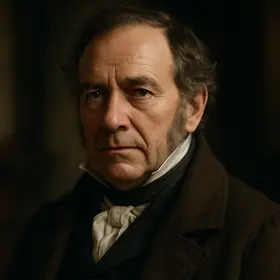
Mr. Gardiner in Pride and Prejudice
Major character
A sensible, gentlemanly merchant and Elizabeth’s uncle who offers steady judgment and practical aid to the Bennet family.
Who is Mr. Gardiner?
Mr. Gardiner is Mrs. Bennet’s brother and the practical, well-bred husband of Mrs. Gardiner. He appears as a calm, sensible contrast to the Bennet household’s turbulence: he hosts Elizabeth in town, accompanies his wife on the Derbyshire tour, and repeatedly provides measured counsel to Jane and Elizabeth. When Lydia elopes with Wickham, Mr. Gardiner takes decisive charge—travelling to London, coordinating with Mr. Bennet and Colonel Forster, and negotiating the search and eventual arrangements that lead to Lydia’s marriage. He oversees inquiries, communicates regularly with Longbourn, and ultimately consults with Mr. Darcy about settling matters. Throughout the novel he acts out of prudence and duty rather than passion, balancing family loyalty with social discretion, and his interventions both soothe immediate crises and shape Elizabeth’s understanding of other characters.
Personality
- Practical
- He leads the efforts to locate Lydia in London, writes detailed letters about progress, and arranges concrete steps for resolving the scandal (Chapters 47–50).
- Sensible
- He is described by Elizabeth as a sensible, gentlemanlike man of trade who offers calm, measured counsel during the Gardiners’ Christmas visit (Chapter 25).
- Responsible
- He persuades Mr. Bennet to remain in London to make inquiries and later negotiates authority to arrange Lydia’s marriage from his house (Chapters 47–49).
- Discrete
- He insists on handling Lydia’s plight with confidentiality and tact, communicating developments in composed letters rather than public complaint (Chapters 48–50).
- Good-humored
- He receives his nieces and their children warmly, and his arrival at Longbourn is greeted with affectionate enthusiasm by the family (Chapter 47).
Character arc
Mr. Gardiner’s presence is consistent from his first appearance as a sensible, gentlemanlike relative to his central role in resolving Lydia’s crisis. Early on he offers steadiness: hosting Elizabeth in town, entertaining the nieces, and providing worldly perspective on engagements and acquaintances (Chapters 25–27). As events darken with Lydia’s elopement, his role deepens from adviser to active agent—he immediately organizes travel, coordinates with Mr. Bennet and Colonel Forster, and carries out practical inquiries in London (Chapters 46–48). He then assumes financial and logistical responsibility, arranging to host the marriage and negotiating settlements to secure Lydia’s future (Chapters 49–50). Finally, after the marriage, he continues to act with measured propriety, corresponding about the arrangements and remaining a model of duty and discretion. He does not undergo a dramatic personal change but rather intensifies the qualities first shown—prudence, industry, and quiet moral authority—becoming indispensable to the family’s recovery.
Relationships
- Mrs. Gardiner His wife, a close and complementary partner who shares his interest in their nieces and accompanies him on social visits and the Derbyshire tour (Chapters 25, 27, 42–45).
- Elizabeth Bennet His niece and frequent correspondent, whom he hosts in town, advises with practical counsel, and supports during crises such as Lydia’s elopement (Chapters 27, 36, 46–52).
- Jane Bennet Another niece whom he treats kindly and whose worries about Bingley and later Lydia he helps to soothe through practical assistance (Chapters 25, 27, 49–51).
- Mr. Bennet Brother-in-law whose distant, literary temperament Mr. Gardiner counterbalances by taking on the active work of inquiries and negotiations in London (Chapters 47–50).
- Lydia Bennet His niece whose elopement he takes responsibility to investigate and resolve, arranging for the marriage to protect the family’s reputation (Chapters 46–51).
- Mr. Wickham The officer involved in Lydia’s elopement whom Mr. Gardiner pursues information about and ultimately negotiates with to secure Lydia’s marriage (Chapters 46–52).
Quotes by Mr. Gardiner
“I am perfectly ready, I assure you, to keep my engagement; and, when your sister is recovered, you shall, if you please, name the very day of the ball.”
Chapter 9Bingley promises Lydia that he will give the ball he had spoken of, setting up a future social event.
“It gives me the greatest pleasure to hear that you have passed your time not disagreeably.”
Chapter 38Collins responds to Elizabeth's thanks by expressing his self-satisfied delight at having provided agreeable hospitality.
“You may, in fact, carry a very favourable report of us into Hertfordshire, my dear cousin.”
Chapter 38He urges Elizabeth to praise the Collins household and their advantageous ties to Lady Catherine and Rosings.
“There is also one other person in the party," he continued after a pause, "who more particularly wishes to be known to you.”
Chapter 43Darcy tells Elizabeth he will introduce his sister to her, a courteous move that both flatters and puzzles Elizabeth, signaling a shift in his behavior.
“It is above eight months. We have not met since the 26th of November, when we were all dancing together at Netherfield.”
Chapter 44Bingley reminds Elizabeth of their last meeting, prompting her pleasure at his exact memory and suggesting a continuing interest in her and her social circle.
“but that was only when I first knew her; for it is many months since I have considered her as one of the handsomest women of my acquaintance.”
Chapter 45Darcy, forced to reply to Miss Bingley's criticisms, quietly asserts his changed assessment of Elizabeth, revealing restraint and inner feeling.
Why Mr. Gardiner matters
Mr. Gardiner embodies practical reason, social responsibility, and the stabilizing influence of mature restraint within the novel. He contrasts with folly and imprudence—especially Mr. and Mrs. Bennet’s extremes—and demonstrates how discretion, industry, and measured charity can avert disaster and restore social standing. His actions link private family duty to public reputation: by negotiating Lydia’s marriage he protects the Bennet name while modeling moral obligation without sentimentality. Through him Austen highlights themes of responsible guardianship, the social consequences of youthful indiscretion, and the value of temperate judgment in maintaining familial and social order.
Chapters with Mr. Gardiner
More Pride and Prejudice characters
 Elizabeth BennetProtagonist
 Jane BennetMajor character
 Mr. BingleyMajor character
 Mr. DarcyMajor character
 Mrs. BennetMajor character
 Mr. BennetMajor character
 Lydia BennetMinor character
 Mr. CollinsMajor character
All chapter summaries ›Characters ›
Read Pride and Prejudice illustrated
Every scene in these notes comes from the Book2Life reader, where the full public-domain text is illustrated as you read, with character portraits and narration. Free in your browser and on iPhone.
