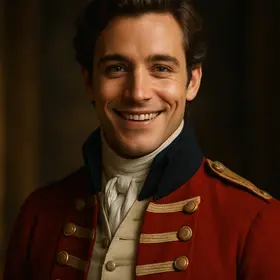
Mr. Wickham in Pride and Prejudice
Major character
A charming, handsome militia officer whose easy manners conceal recklessness and who elopes with Lydia Bennet.
Who is Mr. Wickham?
Mr. Wickham arrives in Meryton as an agreeable, attractive militia officer whose manners quickly win favor, especially with the Bennet sisters. He tells Elizabeth and others a persuasive story that Mr. Darcy injured his prospects, shaping local opinion against Darcy. Wickham courts social goodwill while privately living beyond his means: he accrues debts, declines a clerical living, and pursues a risky intimacy with Georgiana Darcy (as alleged in Darcy's explanatory letter). He avoids Netherfield when he expects Mr. Darcy to be present and later elopes from Brighton with Lydia Bennet, creating a scandal that threatens her and her family's reputation. After being traced to London, Wickham consents to marry Lydia only after negotiations and financial settlements arranged by the Gardiners and (secretly) facilitated and paid for by Mr. Darcy; he then departs with Lydia for a northern posting. Throughout, Wickham acts as a foil to Darcy and a catalyst for several reversals in the plot: he provokes Elizabeth's initial prejudice, precipitates Lydia’s ruin, and ultimately exposes the contrast between appearance and moral character.
In the book: Mr. Wickham is a charming militia officer whose easy manners and attractive appearance quickly win favor in Meryton, especially with the Bennet family. He shares a suggestive past connection with Mr. Darcy that shapes early impressions and tensions among the characters. Serving as a foil to Darcy, Wickham propels key misunderstandings and highlights the novel’s themes of first impressions, judgment, and the gap between appearance and character—without being the moral center of the story.
Personality
- Charming
- In Meryton he is immediately popular for his agreeable manners and good looks when introduced to the Bennet sisters (Chapter 15).
- Persuasive
- He convinces Elizabeth and others with a detailed complaint against Mr. Darcy about a promised living and family injustice (Chapter 16).
- Irresponsible
- Colonel Forster and later Mr. Gardiner report Wickham’s gambling debts and evasive behaviour while searching for Lydia after she elopes (Chapters 48–49).
- Opportunistic
- He accepts a marriage settlement arranged by Mr. Gardiner and secretly supported by Mr. Darcy in order to secure Lydia’s reputation (Chapters 49–52).
- Deceitful
- Darcy’s letter recounts Wickham’s earlier attempts to secure Georgiana Darcy’s fortune and his misrepresentation of events to Elizabeth (Chapter 35).
Character arc
Wickham first appears as a winning, sympathetic officer whose charm and tragic-sounding account of being wronged by Mr. Darcy earn Elizabeth’s confidence. He sustains this amiable public persona—flirting at Mrs. Philips’s, sitting between Elizabeth and Lydia at cards, and speaking fluently about the Darcys—while privately avoiding confrontations that might expose him (he purposely keeps away from Netherfield when Darcy is there). Over time evidence of his recklessness accumulates: reports of debts and evasions surface during the search for Lydia after her elopement from Brighton. The crisis of Lydia’s flight forces Wickham into a marriage with Lydia, but only after external intervention: Mr. Gardiner negotiates with him, and Darcy secretly secures the financial arrangements and commission that make marriage possible. After the wedding Wickham departs with Lydia for a northern posting (Newcastle), and later life shows little moral reformation—he continues a habitually unsettled, extravagant existence that requires occasional financial assistance from his in-laws. Wickham’s outward charm thus remains largely unchanged while the consequences of his choices reshape the Bennet family and expose the limits of social impression.
Relationships
- Elizabeth Bennet He charms and deceives her early on with a flattering account of Darcy, shaping her initial prejudice against Mr. Darcy.
- Mr. Darcy Their contentious past—Wickham’s accusations and Darcy’s later letter accusing Wickham of profligacy and attempted intrigue—frames much of the novel’s tension.
- Lydia Bennet He elopes with Lydia from Brighton, later marries her after financial and social pressure, and leaves her in an unsettled life.
- Mr. Gardiner Mr. Gardiner negotiates with Wickham and helps secure Lydia’s marriage, confronting Wickham’s evasions and debts.
- Mrs. Gardiner She is cautious about Wickham and later reports to Elizabeth the details of Darcy’s interventions in securing Lydia’s marriage.
- Colonel Forster As the militia commander, he is connected to Wickham’s posting and is involved in early searches when Lydia disappears.
Quotes by Mr. Wickham
“He was then, he said, on his way to Longbourn on purpose to inquire after her.”
Chapter 15Bingley’s flattering civil remark to Jane that reinforces his affection and social attentiveness toward the Bennet family.
“His father, Miss Bennet, the late Mr. Darcy, was one of the best men that ever breathed, and the truest friend I ever had;”
Chapter 16Wickham praises the late Mr. Darcy to show his past closeness to the family and to heighten the contrast with the present Mr. Darcy's alleged cruelty.
“I have been a disappointed man, and my spirits will not bear solitude.”
Chapter 16Wickham explains his attraction to military life and social company, revealing his personal needs that justify his pursuit of society.
“I am by no means of opinion, I assure you," said he, "that a ball of this kind, given by a young man of character, to respectable people, can have any evil tendency;”
Chapter 17Mr. Collins rationalizes dancing and society, and uses the occasion to request Elizabeth's first two dances, revealing his officiousness.
“That will do extremely well, child. You have delighted us long enough. Let the other young ladies have time to exhibit.”
Chapter 18Mr. Bennet quietly curtails Mary’s self-important musical display at supper, signaling his ironic, corrective role amid family embarrassment.
“I found," said he, "as the time drew near, that I had better not meet Mr. Darcy;—that to be in the same room, the same party with him for so many hours together, might be more than I could bear, and that scenes might arise unpleasant to more than myself.”
Chapter 21Wickham explains why he chose not to attend the Netherfield ball, implying tension with Darcy and earning Elizabeth's sympathy.
Why Mr. Wickham matters
Wickham embodies the novel’s central contrast between surface charm and moral reality. His easy manners generate favorable first impressions that mislead characters like Elizabeth, illustrating how judgement based on appearance can be fallible. Wickham’s seduction and elopement with Lydia precipitate a family crisis that exposes social vulnerabilities—especially for women—and necessitates discreet, practical intervention. His actions provoke key reversals: they push Elizabeth to reassess her prejudices (particularly after Darcy’s letter) and they reveal Darcy’s capacity for unostentatious generosity. Wickham thus functions as both catalyst and counterpoint: he advances plot turning points while underscoring themes of judgment, reputation, and the difference between seeming virtue and real responsibility.
Chapters with Mr. Wickham
- Chapter 15
- Chapter 16
- Chapter 17
- Chapter 18
- Chapter 21
- Chapter 24
- Chapter 25
- Chapter 26
- Chapter 27
- Chapter 29
- Chapter 32
- Chapter 34
- Chapter 35
- Chapter 36
- Chapter 37
- Chapter 40
- Chapter 41
- Chapter 42
- Chapter 43
- Chapter 44
- Chapter 45
- Chapter 46
- Chapter 47
- Chapter 48
- Chapter 49
- Chapter 50
- Chapter 51
- Chapter 52
- Chapter 53
- Chapter 55
- Chapter 56
- Chapter 57
- Chapter 59
- Chapter 61
More Pride and Prejudice characters
 Elizabeth BennetProtagonist
 Jane BennetMajor character
 Mr. BingleyMajor character
 Mr. DarcyMajor character
 Mrs. BennetMajor character
 Mr. BennetMajor character
 Lydia BennetMinor character
 Mr. CollinsMajor character
All chapter summaries ›Characters ›
Read Pride and Prejudice illustrated
Every scene in these notes comes from the Book2Life reader, where the full public-domain text is illustrated as you read, with character portraits and narration. Free in your browser and on iPhone.
