Comminges in Twenty Years After
Major character
A loyal royal officer who enforces Mazarin's orders, serves as jailer and intermediary between court and prisoners.
Who is Comminges?
Comminges appears as a steady, practical agent of the crown during the Fronde crisis. He is posted at checkpoints (Barrière des Sergens), is wounded while trying to arrest rioters, and follows royal commands to seize important targets — notably executing the order to carry Councillor Broussel away under threat. He functions frequently as Mazarin’s local executor: reporting movements, taking part in night patrols, conveying prisoners, and managing details at Rueil where he oversees the placement and treatment of high-profile detainees. Although his loyalty is clearly to the cardinal and the court, he shows a tempering humanity in small moments — speaking sympathically with Athos about the conditions of captivity and reassuring prisoners about their treatment. Comminges rarely speaks at length in the chapters where he appears; instead he acts efficiently, carries out delicate orders, and serves as a reliable, physical presence representing state authority in chaotic streets and in the cardinal’s residences.
Personality
- dutiful
- He holds the Barrière des Sergens during the night patrol and later carries out the royal order to seize Broussel.
- competent
- Mazarin relies on him for detailed tasks—posting him at checkpoints, entrusting him with prisoner placements at Rueil, and asking him to report on arrivals.
- loyal
- He consistently acts to implement Mazarin’s plans, escorting the cardinal, enforcing arrests, and managing the custody of political prisoners.
- discreet
- He accompanies night missions and delivers sensitive information (such as Mordaunt’s departure) without spectacle.
- sympathetic
- At Rueil he speaks to Athos with a note of sympathy and reassures him that the pavilion is ‘not a true prison.’
Character arc
Comminges’s role across the chapters is steady rather than dramatically transformative. He first appears as an on-the-ground officer wounded in the effort to suppress unrest, which establishes him as someone willing to put himself between royal authority and popular violence. During the escalation of the Fronde he continues as a dependable executor of orders: manning barriers, reporting on movements, and seizing Broussel on the cardinal’s command. As events shift from street confrontations to more confidential maneuvers, Comminges moves into administrative and custodial work at Rueil, where his practical loyalty becomes paired with a quieter tact: instead of brutalizing prisoners he arranges their placement courteously and offers measured reassurances. When the musketeers confront Mazarin and Athos anticipates the cardinal, Comminges acts as the intermediary who warns and prepares — a function that underlines his consistent position between power and people. He ends the sequence as the reliable, low-profile instrument of Mazarin’s authority: unchanged in allegiance, but shown to possess discretion and a humane steadiness that softens the image of an unthinking enforcer.
Relationships
- Cardinal Mazarin Comminges is a trusted agent of Mazarin who executes the cardinal’s orders and reports movements directly to him.
- D'Artagnan He serves alongside and reports situations that involve D'Artagnan, functioning as an operational colleague during patrols and at Rueil.
- Athos He interacts with Athos at Rueil with a measure of sympathy, arranging the comte’s lodging and reassuring him about treatment.
- Broussel Comminges physically carries out the arrest and removal of Councillor Broussel under a royal order.
- Bernouin He relays information and coordinates actions in the palace environment where Bernouin serves Mazarin.
- Porthos He appears in the same court circles and recounts his exploits to the queen in moments when Porthos and other musketeers are present.
Quotes by Comminges
“I am commissioned to seize your person, sir,”
Chapter 44Comminges politely but bluntly announces the royal order to arrest Councillor Broussel, triggering the household's panic.
“When he came here, Monsieur D’Artagnan provoked and braved the soldiers and inferior officers, in order, I suppose, to have his sword back. That mood lasted some time; but now he’s as gentle as a lamb and sings Gascon songs, which make one die of laughing.”
Chapter 82Comminges reports d'Artagnan's change from aggressive resistance to apparent calm, hinting at possible strategy or adaptation rather than mere submission.
Why Comminges matters
Comminges embodies the practical machinery of royal power during civil unrest: the necessary, often anonymous executor of orders who keeps institutions functioning. Through him the text shows how authority is maintained not only by great figures like Mazarin or the musketeers but also by ordinary, competent agents who negotiate force and restraint. His mixture of duty and discreet sympathy highlights the novel’s theme of human complexity beneath political roles — loyalty need not be cruelty, and enforcement can coexist with small mercies. Comminges thereby reinforces the book’s exploration of the tensions between public disorder and the administrative work that preserves—or restores—order.
Chapters with Comminges
More Twenty Years After characters
 PorthosMajor character
 AthosMajor character
 AramisMajor character
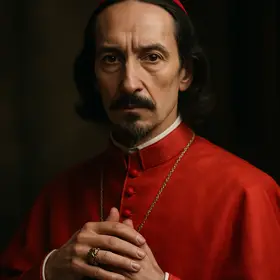 Cardinal MazarinAntagonist
 GrimaudMajor character
 MordauntAntagonist
 MousquetonMinor character
 PlanchetMajor character
All chapter summaries ›Characters ›
Read Twenty Years After illustrated
Every scene in these notes comes from the Book2Life reader, where the full public-domain text is illustrated as you read, with character portraits and narration. Free in your browser and on iPhone.
