
Mustardseed in A Midsummer Night's Dream
Minor character
One of Titania’s attendant fairies, part of the quartet who wait on the enchanted Bottom in the wood.
Who is Mustardseed?
Mustardseed is a small fairy in Titania’s retinue who appears in the enchanted wood while Titania dotes on Bottom (wearing an ass’s head). Though she speaks little, Mustardseed is ordered alongside Peaseblossom, Cobweb, and Moth to attend Bottom’s every whim: to fetch jewels, feed him, and wait on him as the fairy queen crowns him with attention. She helps populate the fairy world and participates in Titania’s pampering of the transformed Bottom in Act 3, Scene 1. Mustardseed is present again in Act 4 when Titania’s enchantment is lifted; she witnesses the reversal of the spell and the reconciliation between fairy and human spheres. Finally, she joins the fairy train in Act 5 when Oberon and Titania bless the palace and the bridal couples, helping to close the play with a note of fairy benediction. Her appearances are brief but she contributes to the play’s atmosphere of mischief, transformation, and the overlap of human and fairy concerns.
In the book: Mustardseed is one of Titania’s attendant fairies, part of the whimsical quartet that waits on her and briefly interacts with Bottom after his transformation. Though a minor character with few lines, Mustardseed helps color the enchanted forest world and underscores the play’s themes of mischief, transformation, and the thin boundary between the human and fairy realms.
Personality
- Obedient
- Follows Titania’s direct orders to wait on Bottom—fetching jewels and attending to his needs (Act 3, Scene 1).
- Attentive
- Stands ready with the other fairies to feed, clothe, and serve Bottom during Titania’s doting (Act 3, Scene 1).
- Playful
- Participates in the light, comic pampering of a bewitched Bottom, underscoring the scene’s whimsical tone (Act 3, Scene 1).
- Witness
- Is present when Titania’s spell is removed and later when the fairies bless the palace, sharing in the resolution (Acts 4 and 5).
Character arc
Mustardseed’s role is stable rather than transformative: she enters as one of Titania’s dutiful attendant fairies and remains in that supportive capacity through the play’s end. In Act 3 she embodies the fairy household’s responsiveness, enacting Titania’s orders to lavish care on the enchanted Bottom and thereby helping to realize the comic absurdity of a fairy court honoring a transformed rustic. In Act 4 she witnesses the undoing of that enchantment—she remains present as Oberon and Puck restore normalcy—demonstrating the fairies’ role as both participants in and observers of magical disorder and its correction. By Act 5 Mustardseed has moved from domestic service in the wood to joining the formal benediction at the palace; her presence with the fairy train during the blessing underlines the restoration of order and the fairies’ function as guardians of marital fortune. She does not undergo a personal change but helps mark the movement from mischief back to harmony.
Relationships
- Titania Servant and attendant who obeys Titania’s commands to wait on and pamper Bottom.
- Peaseblossom Fellow attendant; shares duties alongside Mustardseed in caring for Bottom.
- Cobweb Another of Titania’s fairies who stands with Mustardseed as part of the quartet attending Bottom.
- Moth Companion fairy who participates with Mustardseed in executing Titania’s orders.
- Nick Bottom Recipient of the fairies’ service while under Titania’s enchantment; Mustardseed helps attend to him.
- Oberon Present as the fairy king who oversees the resolution of the enchantment that involves Mustardseed’s household.
Why Mustardseed matters
Mustardseed, though minor and largely silent, reinforces the play’s themes of enchantment, misrule, and reconciliation. By carrying out Titania’s extravagant commands toward Bottom she helps make visible the comic consequences of fairy magic and the porous boundary between human and supernatural spheres. Her presence in the final blessing links the playful disorder she helped enact to the restored social order, showing how the fairies both provoke and repair disruption. As part of the fairy chorus, Mustardseed embodies the natural world’s influence on human affairs and the play’s celebration of renewal and harmony.
Chapters with Mustardseed
More A Midsummer Night's Dream characters
 DemetriusMajor character
 HelenaMajor character
 HermiaMajor character
 LysanderMajor character
 PuckMajor character
 OberonMajor character
 Peter QuinceMajor character
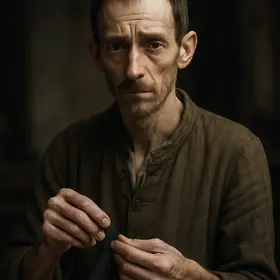 Robin StarvelingMinor character
All chapter summaries ›Characters ›
Read A Midsummer Night's Dream illustrated
Every scene in these notes comes from the Book2Life reader, where the full public-domain text is illustrated as you read, with character portraits and narration. Free in your browser and on iPhone.
Read A Midsummer Night's Dream free
