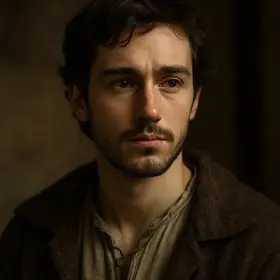
Grisóstomo in Don Quixote
Major character
A brilliant student-turned-shepherd whose passionate, unrequited love for Marcela ends in his death and sparks a moral debate.
Who is Grisóstomo?
Grisóstomo is introduced as a gifted student and poet who abandons academic life to live as a shepherd, composing an overwrought lament for his lost love, Marcela. His “Lay of Chrysostom” is read aloud at the burial assembled by travelers and goatherds; the poem presents his despair as the product of Marcela’s supposed cruelty. Listeners question whether the poetic grief matches Marcela’s known character, and Ambrosio explains that Grisóstomo left voluntarily and allowed jealousy to warp his perception. Marcela herself appears and publicly rejects the idea that her beauty obliges her to return love, defending her choice of solitude and chastising the mourners’ presumption. Grisóstomo’s papers are burned and an epitaph is set upon his grave; his death and the response to his poem draw Don Quixote and the company into a wider argument about love, freedom, and reputation. Though dead, Grisóstomo’s poetic voice and fate catalyze the episode’s central moral and social debate.
In the book: A gifted student and poet who abandons academia for the pastoral life, Grisóstomo becomes central to an early episode that draws Don Quixote and Sancho among goatherds and travelers. His unrequited devotion to the shepherdess Marcela and its aftermath frame a debate about love, personal freedom, and reputation, showcasing Cervantes’s critique of idealized pastoral conventions.
Personality
- romantic
- He composes and leaves an impassioned lament—the ‘Lay of Chrysostom’—that frames his death as the consequence of unreturned love.
- idealistic
- He abandons scholarly life for a pastoral existence, embracing the shepherd’s role as a mode of poetic devotion.
- jealous
- Ambrosio explains that Grisóstomo’s voluntary absence and jealous imaginings soften the apparent indictment of Marcela in his poem.
- self-dramatizing
- His lay casts his suffering in grand, performative terms—presenting death as the fitting funeral of a lover undone by passion.
Character arc
Grisóstomo appears first as a talented student who renounces academic life for the pastoral ideal, transforming himself into a shepherd-poet whose identity centers on devotion to Marcela. He channels his feelings into a public poetic testament—the Lay of Chrysostom—that magnifies his anguish and ultimately accompanies his death. Though the narrative shows him physically absent at the moment of Marcela’s public defense, his choices (voluntary withdrawal from the scholastic world, obsessive attachment, and the composition of the lay) set the stage for the episode’s central conflict. After his death his papers are burned and his epitaph is composed, and he no longer acts in the story; instead, his death functions as a provocation: it forces other characters—mourners, Ambrosio, Marcela, and Don Quixote—into a debate about responsibility, love, and autonomy. Grisóstomo himself does not undergo a transformation during the episode; rather, his fate reveals the limits and dangers of possessive love and romantic self-fashioning, remaining fixed as a cautionary exemplar whose legacy shapes others’ responses.
Relationships
- Marcela The object of his passionate, unrequited love; his lay and death directly provoke her public defense of personal freedom.
- Ambrosio A fellow mourner who contextualizes Grisóstomo’s disappearance and jealous imaginings for the assembled company.
- Don Quixote A listener at the burial whose chivalric impulses lead him to defend Marcela’s virtue and resolve not to pursue her.
- Sancho Panza Present among the company drawn into Grisóstomo’s story and the burial scene, bearing witness to the debate.
- The mourners/company A collective group that reads Grisóstomo’s lay, prepares his grave, burns his papers, and disputes the poem’s portrayal of Marcela.
Why Grisóstomo matters
Grisóstomo functions as a narrative catalyst: his romantic extremity and literary dramatization expose the tension between poetic convention and lived autonomy. His fate provokes Marcela’s forceful defense of individual liberty and challenges readers to question whether passionate suffering confers moral authority. By presenting a lover who dies from unrequited passion and then serving his death up as evidence in a public moral debate, Cervantes undermines pastoral clichés and forces characters to negotiate reputation, consent, and the limits of poetic self-fashioning.
Chapters with Grisóstomo
More Don Quixote characters
 Don QuixoteProtagonist
 Sancho PanzaMajor character
 Dulcinea del TobosoMinor character
- RRocinanteMajor character
 The DukeMajor character
- DDappleMinor character
 The BarberMajor character
 Cide Hamete BenengeliNarrator
All chapter summaries ›Characters ›
Read Don Quixote illustrated
Every scene in these notes comes from the Book2Life reader, where the full public-domain text is illustrated as you read, with character portraits and narration. Free in your browser and on iPhone.
