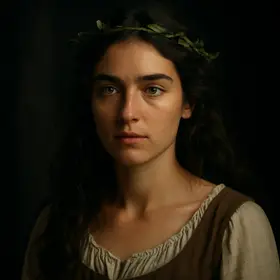
Marcela in Don Quixote
Major character
A wealthy orphaned shepherdess who chooses solitary shepherd life and fiercely defends her right to refuse love.
Who is Marcela?
Marcela is an orphaned, wealthy woman who abandons townly seclusion to live as a shepherdess in the fields. Her striking beauty draws many admirers, including Grisóstomo (Chrysostom), whose obsessive love and eventual death prompt a public burial and debate. At the graveside, Marcela appears and addresses the assembled mourners with a plain, forceful defense of her choices: she insists that being beautiful or wealthy does not obligate her to return affection and that she deliberately chose solitude. She rejects charges of cruelty and refuses to be held responsible for another's passionate despair. After speaking, she departs into the woods, leaving the men to bury Grisóstomo and provoking Don Quixote’s vow to protect her honor and offer chivalric service.
Personality
- Independent
- She leaves seclusion to live alone as a shepherdess, refusing all suitors and choosing solitude over social expectation.
- Forthright
- She climbs the rock above the mourners and openly confronts Ambrosio and the assembly with a blunt defense of her conduct.
- Principled
- She argues that beauty does not create an obligation to love, asserting a moral claim for personal freedom at the burial.
- Resolute
- When accused or pursued after her speech, she departs into the wood and does not relent or plead for sympathy.
Character arc
Marcela's presence in the chapters is consistent rather than developmental: from the first accounts of her life to her public appearance at Grisóstomo’s burial she remains steadfast in her chosen way of life. Initially described by others as a beautiful, secluded heiress who inexplicably takes to the fields, she is the subject of admiration and bitter reproach; Chrysostom’s death crystallizes the community’s impulse to blame her. Rather than changing in response to blame, Marcela directly confronts that impulse: she appears publicly, explains her choices, denies obligation, and refuses to be shamed into conforming. After delivering her defense she withdraws into solitude again, maintaining the independence that defined her from the start. In short, Marcela refuses the community’s efforts to make her repent or explain herself beyond a single forceful statement, and she leaves others—especially Don Quixote—to interpret and react to her stance.
Marcela in pictures


Relationships
- Grisóstomo A rejected admirer whose despair and death provoke the funeral where Marcela publicly defends herself.
- Don Quixote An onlooker who praises her virtue, insists no one pursue her, and later vows to offer chivalric service in her name.
- Sancho Panza Present at the burial as Don Quixote’s companion, he witnesses Marcela’s appearance though he sleeps for part of the night beforehand.
Quotes by Marcela
“I come not, Ambrosio for any of the purposes thou hast named," replied Marcela, "but to defend myself and to prove how unreasonable are all those who blame me for their sorrow and for Chrysostom’s death; and therefore I ask all of you that are here to give me your attention,”
Chapter 14Marcela begins her public defense, rejecting charges that her beauty obliges her to return love or caused Grisóstomo’s death.
Why Marcela matters
Marcela embodies questions of individual liberty, personal responsibility, and the limits of communal judgment. Her refusal to reciprocate love and her insistence on living by her own rules challenge the romantic and social expectations that lead others to moralize about her conduct. By forcing a public debate—one that pits pity and blame against personal autonomy—she foregrounds Cervantes’s exploration of who may claim authority to judge another’s life and how appearances and narratives (like Grisóstomo’s lay) shape that judgment. Marcela’s steadiness complicates sentimental explanations and highlights the book’s skepticism about imposed roles and easy moral conclusions.
Chapters with Marcela
More Don Quixote characters
 Don QuixoteProtagonist
 Sancho PanzaMajor character
 Dulcinea del TobosoMinor character
- RRocinanteMajor character
 The DukeMajor character
- DDappleMinor character
 The BarberMajor character
 Cide Hamete BenengeliNarrator
All chapter summaries ›Characters ›
Read Don Quixote illustrated
Every scene in these notes comes from the Book2Life reader, where the full public-domain text is illustrated as you read, with character portraits and narration. Free in your browser and on iPhone.
