
Caroline Beaufort Frankenstein in Frankenstein
Major character
Victor Frankenstein’s mother; a gentle, charitable woman whose sacrifices shape the family’s bonds and Victor’s early values.
Who is Caroline Beaufort Frankenstein?
Caroline Beaufort Frankenstein is introduced as the daughter of the ruined Beaufort who, after hardship and illness, is rescued by Alphonse Frankenstein and eventually becomes his wife. Formerly impoverished, she rebuilds a household grounded in tenderness, duty, and charity. She fashions the intimate domestic circle that raises Victor and later adopts Elizabeth Lavenza into the family, presenting Elizabeth as a ‘‘pretty present’’ and a companion for Victor. Caroline’s principled attentiveness appears again when she nurses Elizabeth through a deadly scarlet fever infection; her care saves Elizabeth but costs Caroline her life. Through acts of rescue, adoption, and self-sacrifice, Caroline establishes the moral and emotional architecture of Victor’s childhood: lessons in compassion, self-control, and familial duty that are repeatedly invoked after her death. Although she appears only in early family history and on her deathbed, her choices set crucial relationships in motion and create the absence that shapes Victor’s later psychology and motivations.
In the book: Caroline Beaufort Frankenstein is Victor Frankenstein’s mother and a model of tenderness, generosity, and self-sacrifice. Formerly impoverished, she rebuilds a household grounded in charity and affection, shaping Victor’s earliest ideas about duty, care, and family. Her choices—especially her acts of adoption and nurturing—set key relationships in motion and establish moral contrasts that echo throughout the novel, and the profound impact of her absence later in Victor’s life helps drive his character and the story’s central tensions.
Personality
- Compassionate
- She nurses Elizabeth through scarlet fever despite the risk, an act that saves Elizabeth but leads to Caroline’s own death.
- Self-sacrificing
- After Beaufort’s ruin she endures poverty and exhaustion until Victor’s father rescues and later marries her, showing willingness to accept shelter and service.
- Charitable
- She takes the pale orphan Elizabeth from a poor cottage into the Frankenstein household, an act presented as a deliberate, compassionate adoption.
- Nurturing
- Victor describes being the object of his parents’ constant lessons in patience and charity, marking Caroline as a central source of early domestic care.
- Influential
- Her blessings and dying counsel to Victor and Elizabeth are recounted as a moral charge that guides the family after her death.
Character arc
Caroline’s narrative arc is brief and concentrated in family history and a single pivotal deathbed scene. She first appears through Alphonse’s rescue of her after Beaufort’s decline; this rescue leads to marriage, the reconstitution of a stable home, and the shaping of Victor’s early childhood. She demonstrates her convictions by adopting Elizabeth, integrating the child into the family as Victor’s cherished companion. Her final, decisive moment comes when Elizabeth falls ill with scarlet fever; Caroline intentionally tends the sick girl despite warnings, an act that cures Elizabeth but proves fatal to Caroline. She departs the story in death, but her moral presence continues to influence events: her lessons about charity and duty are invoked by Victor as part of the family’s identity, and the void left by her absence becomes a persistent emotional factor in Victor’s life. She does not undergo transformation; rather, her steady qualities and sacrificial end produce enduring consequences for other characters’ developments.
Caroline Beaufort Frankenstein in pictures



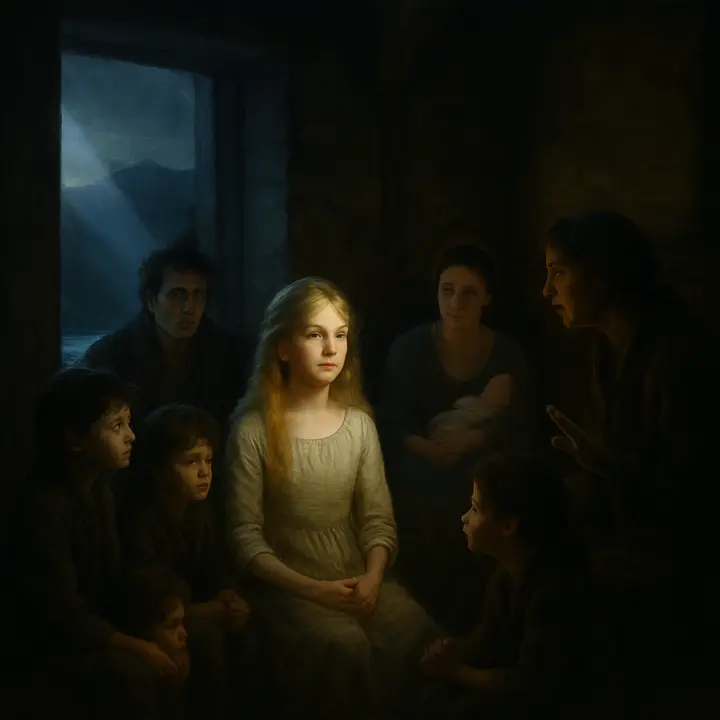


Relationships
- Victor Frankenstein Her son; she raises him with tenderness, charity, and moral instruction and dies blessing his future.
- Alphonse Frankenstein Her husband; Alphonse rescues and later marries Caroline, and their union creates the stable household described by Victor.
- Elizabeth Lavenza Her adopted daughter; Caroline brings Elizabeth into the family and personally cares for her during scarlet fever, an act that costs Caroline her life.
- Beaufort Her father (the ruined merchant); his decline and rescue by Alphonse set the chain of events leading to Caroline’s marriage and later stability.
- Justine Moritz A dependent of the household’s charitable sphere; Caroline’s values help create the family environment in which figures like Justine are taken in and cared for.
Quotes by Caroline Beaufort Frankenstein
“"My children," she said, "my firmest hopes of future happiness were placed on the prospect of your union."”
Chapter 3Mother's dying blessing links family duty and future hopes, motivating Victor and Elizabeth's bond after her death.
Why Caroline Beaufort Frankenstein matters
Caroline embodies the novel’s ideals of maternal charity, domestic duty, and self-sacrifice; she is the moral center of Victor’s early life. Her acts of adoption and care model the human bonds and responsibilities that Victor later neglects through his obsessive scientific pursuits. Her death by selfless nursing underscores the novel’s recurring tension between human sympathy and the consequences of transgression: the household values she fosters stand in stark contrast to the alienation and destructive consequences that follow Victor’s experiments. Even in absence, Caroline’s presence functions as a standard of humane conduct against which the other characters’ choices are measured.
Chapters with Caroline Beaufort Frankenstein
More Frankenstein characters
 Victor FrankensteinProtagonist
 The CreatureMajor character
 Elizabeth LavenzaMajor character
 Alphonse FrankensteinMajor character
 Henry ClervalMajor character
 William FrankensteinMinor character
 Justine MoritzMinor character
 De LaceyMinor character
All chapter summaries ›Characters ›
Read Frankenstein illustrated
Every scene in these notes comes from the Book2Life reader, where the full public-domain text is illustrated as you read, with character portraits and narration. Free in your browser and on iPhone.
