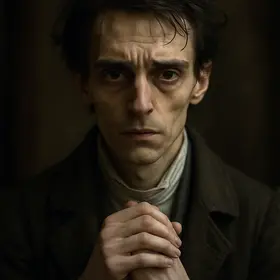
Victor Frankenstein in Frankenstein
Protagonist
A brilliant, obsessive Genevese student whose quest to animate life triggers family tragedy and a vengeful pursuit across Europe.
Who is Victor Frankenstein?
Victor Frankenstein is a privileged Genevese who becomes consumed by natural philosophy. After a happy childhood with Elizabeth and friend Henry Clerval, he studies at Ingolstadt where lectures by M. Waldman and contact with scientific instruments ignite an overpowering ambition to discover the secret of life. He isolates himself, assembles a humanlike being from dead matter, and succeeds—only to recoil in horror at the creature's appearance. Victor then falls into fever and recovery under Clerval's care, returns home to find his youngest brother murdered, and, knowing his creature is responsible, keeps silent for fear of disbelief. His secrecy contributes to the wrongful conviction and execution of Justine. Haunted by guilt, Victor retreats to the Alps, confronts the creature, and is forced into a promise to fabricate a companion. He travels to Britain and the Orkneys to fulfill the pledge, but ultimately destroys the second creature, provoking further murders, including Henry Clerval and Elizabeth. Victor pursues the creature northward until rescued by Walton and dies aboard his ship, having devoted his final days to vengeance and confession.
In the book: Victor Frankenstein is the gifted, obsessive student of natural philosophy whose daring pursuit of forbidden knowledge propels the story. As narrator and protagonist, he embodies Romantic-era ambition and the dangers of intellectual hubris, raising questions about scientific responsibility, the ethics of creation, and the isolating cost of genius. His choices set the novel’s tragedies in motion and frame its enduring debate over creator and creation, duty and consequence.
Personality
- Obsessive
- Chapters 4–5: He secludes himself in an attic workshop and labors through seasons until he discovers the secret of life and assembles the creature.
- Guilty
- Chapters 7–9: After seeing the creature on Mont Salêve and learning of William’s murder, he knows Justine is innocent but cannot speak, and he is racked with remorse following her execution.
- Ambitious
- Chapter 3–4: Waldman’s lectures inspire him with the conviction he will surpass previous scientists and probe creation’s deepest mysteries.
- Isolating
- Chapters 4–6: His single‑minded study causes him to withdraw from family and friends, producing emaciation, fever, and secretiveness that Henry must nurse him through.
- Vindictive
- Chapters 23–24: After Elizabeth’s murder and his father’s death, he devotes himself to a relentless, globe-spanning pursuit of the creature to destroy it.
Character arc
Victor’s arc runs from an idealized, beloved youth to a broken, vengeful man. He begins as a cherished child in a warm household, curious and receptive to the older alchemists (chapters 1–2). At university (chapters 3–4) his intellectual appetite hardens into an obsessive project to create life; when he succeeds (chapter 5) his initial triumph collapses into immediate horror and flight. Convalescing with Clerval (chapters 5–6) offers a brief return to gentler company, but the creature’s crimes (chapters 7–8) and Justine’s execution crush him with guilt and drive him into alpine solitude (chapter 9). After meeting the creature and hearing its tale (chapter 10, 15–17), Victor reluctantly agrees to make a companion, then embarks for Britain and the Orkneys to fulfill the promise (chapters 18–19). In a decisive reversal (chapter 20) he destroys the unfinished female and flees, triggering the murder of Henry and later Elizabeth (chapters 21, 23). From that point his life narrows to a single pursuit of revenge (chapters 24), which exhausts him physically and morally; rescued by Walton, he dies aboard the ship, undone by the consequences of his hubris and secrecy.
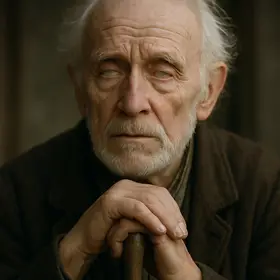
Victor Frankenstein in pictures


Relationships
- The Creature His creation and antagonist: Victor is the creature’s maker and the object of its demand, blame, and eventual vengeance.
- Elizabeth Lavenza Adopted cousin and intended wife: Victor’s childhood companion and the emotional anchor whose murder devastates him.
- Henry Clerval Closest friend and nurse: Clerval restores Victor’s health after the creation but is later murdered, intensifying Victor’s guilt and rage.
- Alphonse Frankenstein Father: a comforting moral presence whose concern tries to pull Victor back to domestic life but cannot penetrate Victor’s secrecy.
- M. Waldman Mentor at Ingolstadt: his lectures and kindness rekindle Victor’s scientific ambition and set the course toward his experiments.
- Justine Moritz Family servant and innocent victim: her wrongful condemnation and execution deeply torment Victor, who knows the truth but stays silent.
Quotes by Victor Frankenstein
“The world was to me a secret which I desired to divine.”
Chapter 2Victor explains his early, intense curiosity and desire to uncover nature's hidden laws, which motivates his studies.
“Natural philosophy is the genius that has regulated my fate; I desire, therefore, in this narration, to state those facts which led to my predilection for that science.”
Chapter 2Victor names natural philosophy as the guiding force of his life and frames the chapter as an account of how that passion began.
“on a sudden I beheld a stream of fire issue from an old and beautiful oak which stood about twenty yards from our house; and so soon as the dazzling light vanished, the oak had disappeared, and nothing remained but a blasted stump.”
Chapter 2A vivid image of the lightning-struck oak that catalyzes Victor's exposure to new ideas about electricity and galvanism.
“From this day natural philosophy, and particularly chemistry, in the most comprehensive sense of the term, became nearly my sole occupation.”
Chapter 4Opens the chapter by stating the shift to intense study that drives the rest of the events.
“After days and nights of incredible labour and fatigue, I succeeded in discovering the cause of generation and life; nay, more, I became myself capable of bestowing animation upon lifeless matter.”
Chapter 4Victor announces his central discovery—both the moment of triumph and the ethical turning point that propels his secret project.
“I will not lead you on, unguarded and ardent as I then was, to your destruction and infallible misery.”
Chapter 4Victor cautions Walton (and the reader) about the dangers of uncontrolled ambition, signaling his own awareness of risk even amid pride.
Why Victor Frankenstein matters
Victor embodies Romantic tensions between boundless ambition and moral responsibility. His rise from curious youth to obsessive creator dramatizes the perils of unchecked scientific pursuit and the consequences of secrecy: his failure to admit responsibility causes collateral suffering (Justine, William, Henry, Elizabeth). His interactions with the creature force questions about creation, duty, and sympathy—does a creator owe rights and care to what he produces? His trajectory also explores isolation’s corrosive effects: intellectual pride alienates him from family and conscience, turning genius into ruin. Ultimately Victor illustrates the novel’s cautionary message: pursuit of knowledge without ethical restraint or accountability leads to destruction.
Chapters with Victor Frankenstein
More Frankenstein characters
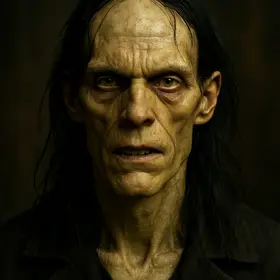 The CreatureMajor character
 Elizabeth LavenzaMajor character
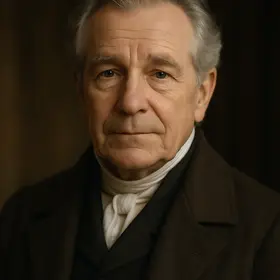 Alphonse FrankensteinMajor character
 Henry ClervalMajor character
 William FrankensteinMinor character
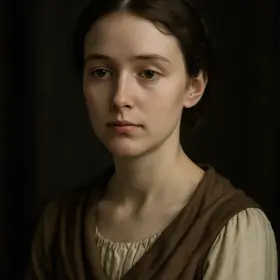 Justine MoritzMinor character
 De LaceyMinor character
 Felix De LaceyMajor character
All chapter summaries ›Characters ›
Read Frankenstein illustrated
Every scene in these notes comes from the Book2Life reader, where the full public-domain text is illustrated as you read, with character portraits and narration. Free in your browser and on iPhone.
