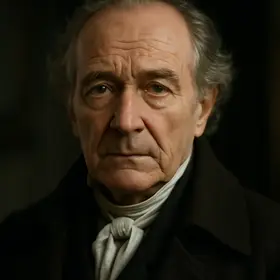
Mr. Kirwin in Frankenstein
Minor character
The Irish magistrate who detains Victor, shows practical compassion, and ensures he receives care and contact with his family.
Who is Mr. Kirwin?
Mr. Kirwin is the magistrate who presides when Victor Frankenstein is brought ashore in a debilitated state and accused of murder. He oversees the initial inquiry into the corpse found on the shore, orders that Victor be shown the body, and arranges for medical attention and a nurse while Victor lies in a cell raving from fever and guilt. Kirwin also ensures that letters are sent to Geneva, which allows Victor’s father to learn of his son’s condition and come to his aid. Although he plays no role in the novel’s central scientific or gothic conflicts, Kirwin practices measured, humane law: he follows procedural steps in the investigation, protects the detainee’s health, and facilitates communication with Victor’s family. His actions move the plot by stabilizing Victor physically and by enabling Alphonse Frankenstein’s arrival, which leads to Victor’s eventual release when the grand jury fails to indict him.
In the book: Mr. Kirwin is the Irish magistrate who presides when Victor Frankenstein is detained abroad; unlike many around him, he shows practical compassion, ensures Victor receives medical care, and facilitates contact with his family, embodying lawful fairness and humane concern without becoming central to the larger scientific-and-gothic drama.
Personality
- procedural
- He orders that Victor be taken to see the corpse and oversees witness testimony during the magistrate’s inquiry.
- compassionate
- He provides a physician and a nurse for Victor while he lies near death in the prison cell.
- fair-minded
- He ensures letters are sent to Geneva so Victor’s father can be informed and attend to his son.
- practical
- He follows legal process and relies on evidence—allowing the grand jury’s refusal to indict when Victor’s whereabouts are corroborated—rather than acting on outrage.
Character arc
Mr. Kirwin’s role is limited but consistent: from the moment Victor is seized and brought before him, Kirwin functions as the steady face of legal order and humane administration. Early, he directs the investigative procedures—he hears witness testimony and orders Victor to view the corpse—establishing his role as an exacting but proper magistrate. When Victor collapses into fever and convulsions upon recognizing Henry Clerval’s body, Kirwin shifts from investigator to caretaker, ensuring medical attention and communicating with Victor’s family. He neither sensationalizes the case nor abandons protocol; instead, he balances custody with care. By arranging correspondence with Geneva and allowing due process (which culminates with the grand jury’s refusal to indict), Kirwin moves Victor from prison toward release. He does not undergo a personal transformation; rather, his consistent application of law and compassion produces a stabilizing effect that helps restore Victor physically and permits the narrative to proceed to its next moral and familial conflicts.
Mr. Kirwin in pictures


Relationships
- Victor Frankenstein The magistrate who detains, questions, provides medical care for, and ultimately facilitates communication between Victor and his family.
- Alphonse Frankenstein Responds to Kirwin’s sending of letters to Geneva by traveling to the magistrate’s town to comfort and aid his son.
- Henry Clerval Presides over the inquiry into Clerval’s found corpse and orders Victor to view the body, which precipitates Victor’s collapse.
Why Mr. Kirwin matters
Mr. Kirwin embodies the humane, procedural side of human institutions in contrast to the novel’s private extremes of obsession and vengeance. His insistence on medical care, orderly investigation, and communication with family shows that law and compassion can temper panic and presumption. Though not central to the gothic drama, he highlights how ordinary civic structures respond to extraordinary events and helps move the story from fevered confinement back toward familial and legal resolution.
Chapters with Mr. Kirwin
More Frankenstein characters
 Victor FrankensteinProtagonist
 The CreatureMajor character
 Elizabeth LavenzaMajor character
 Alphonse FrankensteinMajor character
 Henry ClervalMajor character
 William FrankensteinMinor character
 Justine MoritzMinor character
 De LaceyMinor character
All chapter summaries ›Characters ›
Read Frankenstein illustrated
Every scene in these notes comes from the Book2Life reader, where the full public-domain text is illustrated as you read, with character portraits and narration. Free in your browser and on iPhone.
