
Pindarus in Julius Caesar
Minor character
Cassius’s bondsman and scout who carries messages, watches from a distance, and ultimately obeys a fatal command.
Who is Pindarus?
Pindarus is Cassius’s trusted bondsman and attendant who functions as a scout, messenger, and lookout. He appears at key moments in the camps and on the battlefield, bringing Cassius news (Act 4, sc. 2) and keeping watch from vantage points (Act 5, sc. 3). He listens closely, reports what he sees, and follows orders without public question. His duties place him at the center of Cassius’s immediate decision-making: he delivers impressions of troop movements and personal interactions that shape Cassius’s judgments. In the final scene he misreads events from a distance, communicates a devastating report to Cassius, and then obeys Cassius’s command to kill him, performing the act that precipitates the tragic sequence of deaths discovered moments later. After the killing he flees the scene, leaving others to find the consequences of his obedience.
In the book: You first meet Pindarus as Cassius’s trusted bondsman, the kind of alert attendant who’s always within earshot when orders are given. He matters because he scouts, carries messages, and quietly keeps Cassius informed when tensions are high around the camp.
Personality
- Obedient
- When Cassius commands him to kill his master on the hill, Pindarus complies and stabs Cassius (Act 5, sc. 3).
- Watchful
- He is sent up the hill to keep watch and reports on Titinius’s movements and the shouting of horsemen (Act 5, sc. 3).
- Reliable messenger
- He brings Cassius a message in the camp before Brutus’s tent, functioning as Cassius’s immediate link to events (Act 4, sc. 2).
- Literal-minded
- He misreads the scene on the hill and reports Titinius as being surrounded and taken, a report that precipitates Cassius’s suicide (Act 5, sc. 3).
Character arc
Pindarus begins as a steady, background presence whose duties are to observe and relay information for Cassius. In earlier scenes he performs these tasks reliably: carrying a message to Brutus’s camp and acting as Cassius’s immediate attendant when tensions rise (Act 4, sc. 2). On the battlefield his role intensifies; from an elevated vantage he watches Titinius and the surrounding troops and reports what he sees (Act 5, sc. 3). That report—based on distance and appearance—leads Cassius to believe disaster has befallen his friend. Pindarus does not question Cassius’s interpretation or his final order; instead he moves from reporting to directly causing Cassius’s death by adhering to the command to stab him. After the act he flees, a final movement away from the army and the consequences of the misread scene. Pindarus’s arc is not one of moral transformation but of escalation in duty: a bondsman whose obedience moves him from messenger to executioner, with the aftermath left to others to reckon with.
Relationships
- Cassius His master and commander whom he serves closely, carrying messages, watching for news, and ultimately killing at Cassius’s command.
- Titinius A focal point of his watch: Pindarus observes Titinius from a hill and reports his apparent capture, triggering Cassius’s fatal decision.
- Brutus An opposing commander present in the camp whose actions and orders shape the tension Pindarus reports but with whom Pindarus has no direct intimate exchange.
- Messala One of the officers who later finds Cassius dead; Pindarus’s flight leaves Messala to confront the aftermath of the killing.
- Mark Antony Pindarus reports that Antony is in Cassius’s tents during the heat of battle, marking Antony’s presence as part of the battlefield confusion.
Why Pindarus matters
Pindarus embodies the theme of obedience and the tragic consequences of misperception. As a conduit of information, his reports shape leaders’ decisions and show how distant vantage points and literal readings of events can lead to irreversible actions. His unquestioning loyalty transforms him from neutral messenger into the agent of a fatal order, highlighting how followers’ complicity and the limits of perspective contribute to the play’s unraveling of command, trust, and responsibility.
Chapters with Pindarus
More Julius Caesar characters
 BrutusProtagonist
 CassiusAntagonist
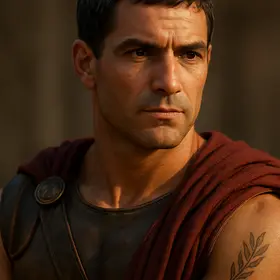 Mark AntonyAntagonist
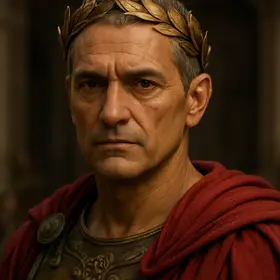 Julius CaesarProtagonist
 CascaMajor character
 LuciliusMajor character
 TitiniusMajor character
 Decius BrutusMajor character
All chapter summaries ›Characters ›
Read Julius Caesar illustrated
Every scene in these notes comes from the Book2Life reader, where the full public-domain text is illustrated as you read, with character portraits and narration. Free in your browser and on iPhone.
