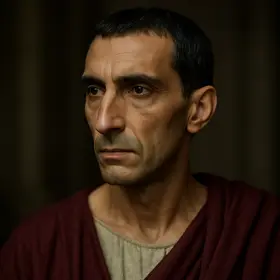
Trebonius in Julius Caesar
Minor character
A discreet, tactful senator who joins Cassius’s plot and is trusted to handle delicate tasks within the conspiracy.
Who is Trebonius?
Trebonius appears as a sober, tactful Roman senator who moves easily among the city’s power players. He listens more than he speaks, participating in Cassius’s recruitment of Brutus and acting as one of the conspirators who accompany Brutus in the orchard. Trebonius is entrusted with quiet, practical duties: he remains composed in tense company, and at the assassination he pulls Mark Antony away from Caesar so the conspirators can attack without immediate interruption. Though he does not deliver speeches or lead the plot, his steady presence and willingness to perform discrete, awkward work make him useful to the group. Trebonius’s actions are pragmatic: he helps manage the logistics and interpersonal risks of the conspiracy rather than argue its principles, and his behavior underscores the conspirators’ need for reliable operatives who can carry out sensitive tasks without attracting attention.
In the book: When we first meet him, he’s a sober, tactful Roman statesman who moves easily among the city’s power players. He keeps his voice low, pays attention, and proves useful in tense moments—especially when someone needs to be quietly steered aside or a plan handled without fuss.
Personality
- Tactful
- He moves Antony aside at the Capitol to keep him away from Caesar while the conspirators prepare to strike.
- Sober
- When introduced among Cassius’s recruits he behaves quietly and without grandstanding during the serious debate in Brutus’s orchard.
- Practical
- He accepts the conspirators’ plan and performs the hands-on job of steering Antony away to reduce immediate complications at the assassination.
- Trustworthy
- Cassius and the other conspirators include him in their inner group and rely on him for a delicate role at the Capitol.
Character arc
Trebonius is consistent from first appearance to last: he arrives as a calm, attentive statesman in the company of Cassius, participates in the conspirators’ plan in Brutus’s orchard, and carries out a discrete but crucial task at the assassination. He does not undergo a pronounced internal transformation in the provided scenes; rather, his role emphasizes steadiness and competence. In Act 1 he establishes himself among the plotters as reliable and composed. In Act 2 he stands with the disguised conspirators who seek Brutus’s agreement, showing that he is committed to the cause and comfortable acting in clandestine circumstances. In Act 3 he executes the operational detail of drawing Antony away from Caesar, enabling the murder to proceed. Across these moments Trebonius remains a behind-the-scenes operator: his convictions are implied by action rather than spelled out, and he does not take on leadership or moralizing speech. The arc, therefore, is one of functional consistency—he performs the supporting, practical duties the conspiracy requires until the deed is done.
Relationships
- Cassius An ally and recruiter who includes Trebonius in the inner circle of conspirators and trusts him with a discreet role.
- Brutus A fellow conspirator present when Brutus is persuaded to join; Trebonius supports Brutus’s leadership by participating without challenging him.
- Mark Antony A target of Trebonius’s tactical action at the assassination—Trebonius draws Antony aside to keep him from interrupting the murder.
- Casca A co-conspirator who, like Trebonius, takes part in the orchard meeting and the attack in the Senate.
- Cinna Another conspirator present in recruitment and planning; they operate together within Cassius’s group.
Why Trebonius matters
Trebonius represents the practical, administrative side of political violence: the conspiracy requires not only rhetoric and motive but also quiet operatives who manage human logistics. His presence highlights how ordinary, disciplined men enable extraordinary acts—the assassination depends on small, tactical moves as much as on ideology. By performing an unglamorous but essential task, Trebonius underscores themes of complicity and collective responsibility: the murder of Caesar is a group action sustained by many hands, including those who never speak aloud for the cause. His steadiness also contrasts with more rhetorically driven characters, reminding readers that power is often seized through organized, pragmatic cooperation rather than single heroic gestures.
Chapters with Trebonius
More Julius Caesar characters
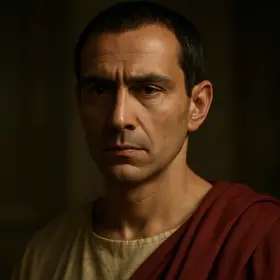 BrutusProtagonist
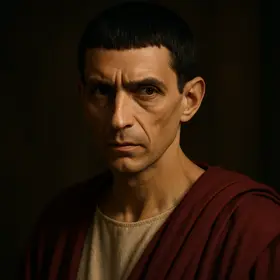 CassiusAntagonist
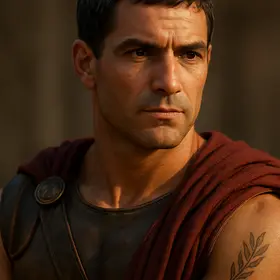 Mark AntonyAntagonist
 Julius CaesarProtagonist
 CascaMajor character
 LuciliusMajor character
 TitiniusMajor character
 Decius BrutusMajor character
All chapter summaries ›Characters ›
Read Julius Caesar illustrated
Every scene in these notes comes from the Book2Life reader, where the full public-domain text is illustrated as you read, with character portraits and narration. Free in your browser and on iPhone.
