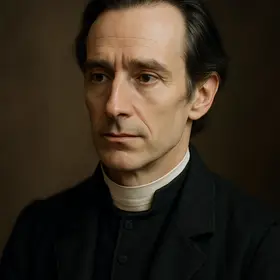
Camden Farebrother in Middlemarch
Major character
The conscientious, modest vicar of St. Botolph’s who counsels neighbors and seeks to reconcile principle with small-town pressures.
Who is Camden Farebrother?
Camden Farebrother is the sympathetic, practical parson whose temperate judgment, learning, and domestic steadiness make him a respected presence in Middlemarch. He wants to preserve moral integrity and independence for himself and others while avoiding needless public conflict; he also desires modest improvement in his position and to provide for his family. Across the chapters he listens, advises, and intervenes in delicate situations—urging Fred Vincy toward honesty, explaining parish politics to Lydgate, defending Lydgate’s character to skeptical friends, and mediating between competing interests at the Infirmary. He celebrates a small personal advancement when offered the Lowick living and accepts the responsibilities it brings. Farebrother rarely seeks credit; instead he uses quiet conversation, pastoral authority, and personal example to shape outcomes, attempting to temper rumor, counsel the wavering, and support those who face social peril without sacrificing his own conscience.
In the book: Reverend Camden Farebrother is the conscientious vicar of St. Botolph’s, a gifted scholar and amateur naturalist whose kindness and integrity make him a trusted friend and counselor in Middlemarch. Living modestly while supporting his family, he balances worldly pressures with moral principle, offering guidance to younger characters and quietly shaping several key relationships and decisions without seeking the spotlight.
Personality
- Conscientious
- He counsels Fred Vincy candidly about debts and vocation (Ch. 52) and weighs the delicacy of investigating Lydgate’s alleged compromise (Ch. 72).
- Moderate
- At the Infirmary vote he greets Lydgate with steady friendliness despite political pressure and admits the difficulty of absolute independence (Ch. 18, 17).
- Kind
- He visits Caleb Garth to speak on Fred’s behalf and gently relieves Mary Garth’s conscience about the burned will (Ch. 40).
- Practical
- He studies Lydgate’s entomological collection and gives pragmatic advice about combining vocation with local alliances (Ch. 17).
- Discreet
- He warns Dorothea that probing the Bulstrode-Lydgate affair is delicate and counsels restraint while acknowledging possible dishonorable human failure (Ch. 72).
Character arc
Farebrother first appears as the genial, modest vicar at home and in parish affairs—interested in natural history, tolerant of small vanities, and alert to local rivalries. Early on he plays a private supporting role: admonishing Fred about reputation, entertaining Lydgate, and showing the quiet content of a parsonage life (Ch. 12, 17, 14). When Lydgate arrives in town he becomes a friend and adviser, balancing sympathy for reform with realistic warnings about political entanglements (Ch. 13, 18). As scandals and hospital politics escalate, Farebrother’s role shifts toward mediation: he listens to Dorothea, weighs the risks of inquiry into Bulstrode’s loan, and counsels measured action rather than impulsive intervention (Ch. 72). After his appointment to Lowick he takes on greater pastoral responsibility, frankly presenting Fred’s plea to Mary and helping to settle domestic dilemmas (Ch. 52). By the later episodes he is a steady moral touchstone—willing to believe in people’s honor yet alert to the compromises demanded by social life—and he quietly helps sustain Lydgate’s reputation while maintaining his own integrity.
Relationships
- Tertius Lydgate Friend and confidant who admires Farebrother’s temperate judgment; Farebrother counsels and sympathizes with Lydgate amid hospital politics.
- Fred Vincy Pastoral adviser who admonishes Fred about debts, reputation, and vocation and later advocates for him when he doubts his path (Ch. 12, 52).
- Mary Garth Respected interlocutor: Farebrother speaks candidly with her about Fred’s suit and relieves her conscience about the Featherstone will (Ch. 40, 52).
- Dorothea Brooke Collaborator in public-spirited action: she consults and is influenced by Farebrother’s caution when she seeks to defend Lydgate (Ch. 72).
- Nicholas Bulstrode Local rival in parish affairs whose influence threatens Farebrother’s place on the infirmary; Farebrother is wary of Bulstrode’s power (Ch. 13, 71).
- Mrs. Farebrother Domestic anchor: she presides at the parsonage and figures in the parochial household life that grounds Farebrother’s character (Ch. 17, 52).
Quotes by Camden Farebrother
“"My mother is like old George the Third," said the Vicar, "she objects to metaphysics."”
Chapter 17Farebrother jokes about his mother's conservative outlook to introduce the household’s plain, non-metaphysical values.
“"You must learn to be bored, remember."”
Chapter 17Farebrother teasingly advises Lydgate as he shows him the painstakingly arranged entomological drawers, signaling small-town demands on patience.
“"I have not yet told you that I have the advantage of you, Mr. Lydgate, and know you better than you know me."”
Chapter 17Farebrother reveals prior knowledge of Lydgate through Trawley and signals the intimacy of local networks and reputations.
““Eros has degenerated; he began by introducing order and harmony, and now he brings back chaos.””
Chapter 36Farebrother teases Lydgate about the disorder in his laboratory caused by love, highlighting how romance disrupts scientific routine.
“He has asked me to consult you about his going into the Church.”
Chapter 52Farebrother explains to Mary that Fred wants her feeling to decide whether he should enter the clergy.
“character is not cut in marble—it is not something solid and unalterable. It is something living and changing, and may become diseased as our bodies do.”
Chapter 72Farebrother tempers Dorothea’s certainty by reminding her that reputation and character can change and require evidence.
Why Camden Farebrother matters
Farebrother embodies Middlemarch’s moral centre of quiet, patient good sense. He shows how modest virtues—charity, discretion, and steady counsel—hold communities together amid rumor, ambition, and scandal. By mediating between idealism and compromise, supporting reformers like Lydgate while warning against imprudent entanglements, he dramatizes Eliot’s theme that moral action more often requires prudent sympathy than heroic declamations. His domestic contentment and low-key service emphasize the novel’s respect for unostentatious influence and the idea that social healing depends on everyday moral work rather than public triumphs.
Chapters with Camden Farebrother
- Chapter 12
- Chapter 13
- Chapter 14
- Chapter 17
- Chapter 18
- Chapter 26
- Chapter 27
- Chapter 29
- Chapter 31
- Chapter 36
- Chapter 38
- Chapter 40
- Book 5, Chapter 45
- Book 5, Chapter 46
- Chapter 50
- Chapter 52
- Chapter 53
- Chapter 54
- Chapter 56
- Chapter 57
- Chapter 58
- Chapter 59
- Chapter 63
- Chapter 70
- Chapter 71
- Chapter 72
- Chapter 75
- Chapter 76
- Chapter 77
- Chapter 80
- Chapter 81
- Chapter 82
- Finale
More Middlemarch characters
 Dorothea BrookeProtagonist
 Tertius LydgateMajor character
 Will LadislawMajor character
 Mr. BrookeMajor character
 Sir James ChettamMajor character
 Rosamond VincyMajor character
 Nicholas BulstrodeMajor character
 Mr. VincyMajor character
All chapter summaries ›Characters ›
Read Middlemarch illustrated
Every scene in these notes comes from the Book2Life reader, where the full public-domain text is illustrated as you read, with character portraits and narration. Free in your browser and on iPhone.
