Narrator in Moby-Dick
Narrator
The shipboard narrator and observer who reports whaling life, natural history, and moral reflections from the Pequod's deck.
Who is Narrator?
The narrator functions as the Pequod's observing mind and public voice, shifting between practical whaling reportage, anatomical and technical description, and moral commentary. He recounts seamen's food habits and cultural ironies (Chapter 65), takes a close, quasi-scientific look at the sperm whale's head and sensory organs (Chapter 74), describes the grease, gear, and skill that make pitchpoling successful (Chapter 84), and records tense moments aboard ship during storms and the climactic chase (Chapters 123 and 134). In action scenes he details procedures—how harpoons, lances, and boats are used—and in quieter moments he meditates on human hypocrisy, the whale's physiology, and the crew's psychology. He wants to present the whale and whaling life fully: anatomically, technically, and ethically, so the reader can appreciate both the craft and its contradictions. He narrates events as they happen, contextualizes them with history and metaphor, and frames Ahab's obsession and the crew's response for the reader.
Personality
- Inquisitive
- In Chapter 74 he studies and compares the sperm and right whale heads with close anatomical curiosity, even speculating about their vision.
- Observant
- In Chapter 84 he notes Queequeg meticulously greasing his boat and describes Stubb's poised technique during pitchpoling.
- Analytical
- In Chapter 84 he explains the construction and functional reasons for using a lighter, longer lance over a harpoon in pitchpoling.
- Ironical
- In Chapter 65 he indicts urban gastronomic refinement by comparing it to tacit cannibalism and social hypocrisy.
- Reflective
- In Chapter 123 he frames Starbuck's imagined use of Ahab's musket as a moral crisis, weighing duty against violent temptation.
Character arc
Across these chapters the narrator remains a steady, interpretive presence rather than a changing participant. He opens by blending anecdote and moral criticism about human eating habits and hypocrisy (Ch. 65), moves into meticulous anatomical and sensory description of the whale to deepen reader understanding (Ch. 74), and then applies that technical attention to the particulars of seamanship and violence in the pitchpoling account (Ch. 84). When storms and human drama intensify (Ch. 123), his voice shifts to close, sympathetic portrayal of crew psychology—Starbuck's temptation, Ahab's arsenal—while still maintaining analytical distance. In the chase's chaos (Ch. 134) he conveys spectacle, damage, and loss with factual clarity and moral framing: he records Fedallah's disappearance and Ahab's unbroken resolve. Throughout, he does not undergo a personal transformation; rather, his method broadens—melding natural history, technical reportage, and ethical commentary—to make the whale, the hunt, and Ahab's obsession intelligible to the reader even as events grow more extreme.
Relationships
- Stubb He depicts Stubb as a calm, skilled whaleman, highlighting Stubb's pitchpoling composure and appetite anecdotes.
- Queequeg He notices Queequeg's practical seamanship, such as Queequeg's deliberate greasing of his boat before a chase.
- Tashtego He records Tashtego's successful harpooning and later role in salvaging the sperm whale's teeth for practical use.
- Starbuck He closely narrates Starbuck's moral struggle with Ahab's musket and the burden of potential violence for the crew's safety.
- Ahab He frames Ahab as the driving, obsessed captain whose commands and fate dominate the ship and narrative focus.
- Fedallah He reports Fedallah's mysterious absence after the violent encounters in the second day of the chase, noting the loss to Ahab's crew.
Quotes by Narrator
“That mortal man should feed upon the creature that feeds his lamp, and, like Stubb, eat him by his own light, as you may say;”
Chapter 65Opens the chapter with the central ironic image: humans eating the whale that provides their lamp-oil.
“In the long try watches of the night it is a common thing for the seamen to dip their ship-biscuit into the huge oil-pots and let them fry there awhile.”
Chapter 65Describes a practical, seafaring method that makes whale oil palatable and highlights sailors’ intimate use of the whale.
“Cannibals? who is not a cannibal?”
Chapter 65A rhetorical provocation indicting supposedly civilized gourmands and exposing hypocrisy about eating animals.
“Here, now, are two great whales, laying their heads together; let us join them, and lay together our own.”
Chapter 74Opens the chapter by presenting the sperm and right whale heads as objects for comparative study on the Pequod.
“What a really beautiful and chaste-looking mouth! from floor to ceiling, lined, or rather papered with a glistening white membrane, glossy as bridal satins.”
Chapter 74Vivid description of the sperm whale’s mouth interior, contrasting beauty with the subsequent depiction of the dangerous lower jaw.
“There are generally forty-two teeth in all; in old whales, much worn down, but undecayed; nor filled after our artificial fashion.”
Chapter 74Practical detail about the number and condition of teeth, leading into the description of their extraction and use as whalebone.
Why Narrator matters
The narrator functions as the reader's intellectual and moral guide: he supplies technical knowledge about whales and whaling, records dramatic events, and continually interprets human behavior and ethics. His shifting registers—from clinical description to ironic moralizing—underscore the novel's themes of human mastery over nature, the costs of that mastery, and the blurred line between civilization and violent appetite. By combining factual detail with reflective commentary, he frames Ahab's obsession and the crew's complicity as phenomena to be examined, not merely witnessed, thus making the book a sustained interrogation of knowledge, violence, and responsibility.
Chapters with Narrator
More Moby-Dick characters
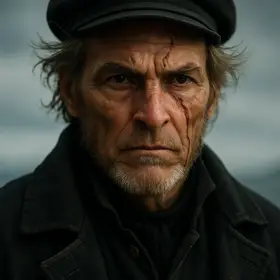 Ahab
Ahab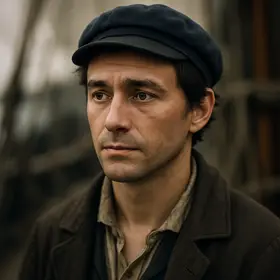 Ishmael
 Stubb
Stubb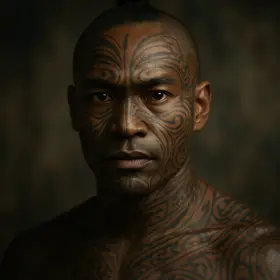 Queequeg
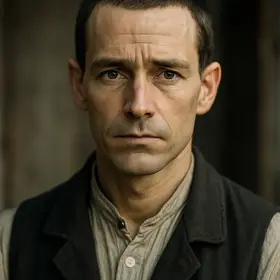 Starbuck
 Flask
Flask Tashtego
 Moby Dick
All chapter summaries ›Characters ›
Read Moby-Dick illustrated
Every scene in these notes comes from the Book2Life reader, where the full public-domain text is illustrated as you read, with character portraits and narration. Free in your browser and on iPhone.
