Pip in Moby-Dick
Minor character
Pequod’s youthful cabin-boy whose innocence and later breakdown give a human, vulnerable counterpoint to the ship’s violence.
Who is Pip?
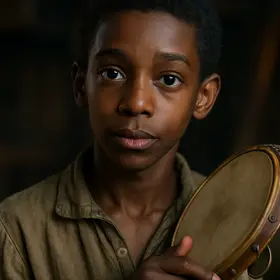
Pip is a young cabin-boy from Alabama who serves among the Pequod’s crew as a gentle, musical presence, often playing a tambourine for the forecastle. He participates in shipboard life—singing with the men, cowering in storms, and joining boat crews—until a traumatic episode in which he becomes entangled in a whale-line and is momentarily abandoned at sea. The physical rescue restores his body but not his sanity: after floating alone on the vast ocean he returns transformed, described as ‘mad’ yet manifesting sudden, luminous insights into larger metaphysical realities. He alternates between childish buffoonery and startlingly profound utterances, drawing unusual attention from Ahab, who both mocks and oddly protects him, and from other crewmembers who react with a mix of derision, pity, and unease. Pip does not drive the voyage’s action but his altered state and intermittent clairvoyant remarks puncture the crew’s bravado and highlight the human cost of whaling life.
In the book: Pip is the Pequod’s young cabin boy, a gentle, musical presence whose innocence highlights the harshness of life at sea. After a traumatic episode that leaves him psychologically altered, he becomes a poignant emblem of vulnerability and truth, his fragmented insights unsettling the crew and illuminating the moral stakes of the voyage without driving its action.
Personality
- Innocent
- In the forecastle he plays the tambourine for the men and cowers beneath the windlass during a squall, pleading for mercy.
- Musical
- He provides music for the midnight forecastle revelry, leading dancers and chants before the storm scatters them.
- Traumatized
- After being left adrift when the whale runs, he returns physically saved but mentally broken and is called mad by the crew.
- Visionary
- While floating alone he experiences a metaphysical plunge and returns with strange, luminous insights that unsettle the ship.
Character arc
Pip first appears as a buoyant, somewhat comic child of the forecastle—musical, playful, and vulnerable—participating in crew songs and jesting interactions. During a violent squall he demonstrates fear and superstition, invoking white squalls and a ‘big white God,’ which foreshadows his emotional fragility. The arc turns decisively in the boat-encounter when, frightened by a whale, he leaps, becomes entangled in the line, and is abandoned far astern as the whale runs; though the crew later plucks him from the sea, the experience shatters him. From that point forward Pip occupies a transformed role: outwardly a rescued boy, inwardly a broken, prophetic figure whose laughter, mummery, and pronouncements register as signs of a mind split open by the ocean’s vastness. He shifts from comic cabin-boy to a poignant emblem of psychological ruin and uncanny insight, never returning to his original innocence but gaining a disturbing clarity that isolates him socially while deepening the voyage’s moral texture.
Relationships
- Ahab Ahab alternates between odd affection and authoritative distance, claiming Pip for his cabin and speaking tenderly to him while forbidding him on deck at certain moments.
- Stubb Stubb is the mate whose boat Pip serves in and who orders the line cut to save Pip, later lecturing and threatening him after the mishap.
- Queequeg Queequeg shares close physical proximity in the cabin scene, and Pip alternately mocks and exalts him while entreating him about the afterlife.
- Tashtego Tashtego reacts with fury when Pip leaps in the boat and nearly severs the line, blaming the boy’s perceived cowardice.
- Carpenter The Carpenter works near where Pip follows Ahab and explains the coffin’s repurposing; Pip watches these transformations and is drawn into the coffin life-buoy imagery.
- Narrator The Narrator records Pip’s songs, fears, abandonment, and altered speech, interpreting the boy as a poignant symbol within the voyage’s moral landscape.
Quotes by Pip
“Oh, thou big white God aloft there somewhere in yon darkness, have mercy on this small black boy down here; preserve him from all men that have no bowels to feel fear!”
Chapter 40Pip’s terrified prayer as he cowers during the approaching squall, invoking whiteness and vulnerability.
“I look, you look, he looks; we look, ye look, they look.”
Chapter 99Pip repeats a simple grammatical chant while staring at the coin, offering an eerie, reductive observation on shared perception.
“Here, then, I’ll seat me, against the transom, in the ship’s full middle, all her keel and her three masts before me.”
Chapter 129Pip settles into Ahab’s reserved chair and launches into an imaginative, ceremonial monologue where he plays host to phantom captains.
Why Pip matters
Pip embodies the human vulnerability that the Pequod’s brutal economy tends to crush; his breakdown dramatizes the psychological cost of whaling and the inscrutable power of the sea. As a child who becomes both comic relief and prophetic witness, he exposes the crew’s moral blindness and the ship’s latent cruelties. Pip’s brief transcendence—his ‘vision’ while adrift—and subsequent marginalization point to themes of abandonment, the limits of communal solidarity, and how contact with the infinite can alienate an individual from ordinary social life, making him a concentrated emblem of the novel’s meditations on humanity, madness, and the abyss.
Chapters with Pip
More Moby-Dick characters
 Ahab
Ahab Ishmael
 Stubb
Stubb Queequeg
 Starbuck
 Flask
Flask Tashtego
 Moby Dick
All chapter summaries ›Characters ›
Read Moby-Dick illustrated
Every scene in these notes comes from the Book2Life reader, where the full public-domain text is illustrated as you read, with character portraits and narration. Free in your browser and on iPhone.
