Sperm Whale in Moby-Dick
Major character
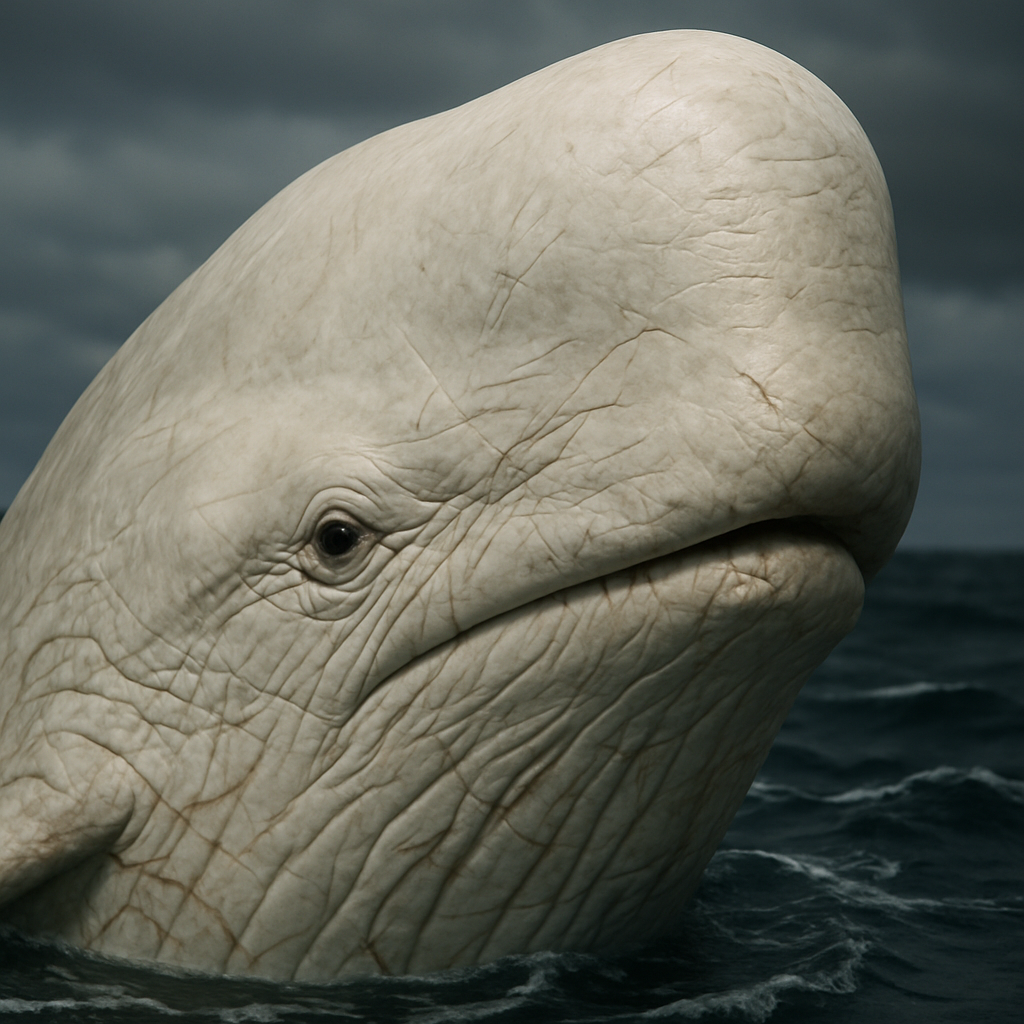
A prodigious sperm whale—physically inscrutable, economically valuable, and philosophically menacing in Ishmael’s meditations.
Who is Sperm Whale?
The Sperm Whale is the large cetacean Ishmael repeatedly scrutinizes from the Pequod’s deck. Rather than appearing as a single plot-driving agent, the whale functions as an object of anatomical, physiological, and cultural inquiry: Ishmael describes its head and forehead, hypothesizes a battering‑ram function for its spermaceti chambers, catalogues its teeth and the ways men harvest them, and traces the origin and value of ambergris that the whale leaves behind. The whale is both material commodity—source of teeth, spermaceti, and ambergris—and a living force whose frontal mass and hidden anatomy may explain destructive encounters with whaleboats. Throughout these chapters the creature resists human attempts to read its mind, alternately suggesting genius, doom, indomitability, and even a perfumed presence in the sea.
Personality
- Imposing
- Ishmael dwells on the whale’s vast, pleated brow as a full-front feature that suggests deity and doom (Chapter 79).
- Physically inscrutable
- The whale’s apparent forehead is mostly spermaceti and hides a comparatively tiny brain far back in the skull (Chapter 80).
- Formidably built
- Ishmael argues the whale’s forehead and internal honeycombed chambers function like a battering-ram, concentrating tremendous force (Chapter 76).
- Economically useful
- Forty-two teeth are hauled up and sawn into slabs for whalebone; ambergris found at sea is prized for perfumes and other uses (Chapter 74; Chapter 92).
- Ambiguously dignified
- Ishmael compares the whale to a sphinx and suggests its brow bears a silent genius that invites mythic interpretation (Chapter 79).
Character arc
The Sperm Whale does not undergo a moral or psychological transformation but is reframed progressively by Ishmael’s observations. First, it appears as a concrete source of material goods: teeth pulled and converted into whalebone (Chapter 74). Then attention shifts to functional anatomy—what looks like mere bulk becomes a specialized frontal structure whose spermaceti chambers Ishmael hypothesizes act as a buoyant, impact‑absorbing battering‑ram (Chapter 76). Next the whale is elevated into physiognomic and almost metaphysical territory: its missing nose, vast brow, and tiny visible brain make it an enigma that mocks ordinary phrenological reading yet suggests indomitability (Chapters 79–80). Finally the whale enters the sphere of cultural commodity and scent—ambergris turns the creature into a source of fragrant, highly valued material, countering vulgar assumptions about whales’ foulness (Chapter 92). Across these moments the whale remains materially the same, but human understanding of its body, agency, and cultural meaning deepens and complicates.
Relationships
- Ishmael Object of Ishmael’s persistent anatomical, philosophical, and moral scrutiny and the primary lens through which the whale is interpreted.
- Queequeg One of the whalemen (along with Daggoo and Tashtego) who help extract the sperm whale’s teeth after a hunt (Chapter 74).
- Daggoo A crewman who, with Queequeg and Tashtego, participates in hauling and processing the whale’s lower jaw and teeth (Chapter 74).
- Tashtego A harpooner who helps remove and prepare the sperm whale’s teeth for conversion into useful whalebone slabs (Chapter 74).
- Pequod The shipboard vantage from which the whale is studied and from whose deck Ishmael invites readers to inspect the sperm whale’s anatomy (Chapter 74).
- Moby Dick A fellow cetacean in the cast list whose famed identity the sperm whale helps personify—both stand as emblematic, inscrutable forces of the sea.
Why Sperm Whale matters
The Sperm Whale embodies central tensions in the book: the limits of human knowledge and the drive to commodify nature. Anatomically immense yet mentally obscured, it resists phrenological and moral certainty even as its body yields valuable commodities—teeth, spermaceti, ambergris. Ishmael’s shifting descriptions turn the whale into a site where science, myth, commerce, and the sublime intersect, forcing characters and readers to confront nature’s inscrutability, material utility, and potential for violence.
Chapters with Sperm Whale
More Moby-Dick characters
 Ahab
Ahab Ishmael
 Stubb
Stubb Queequeg
 Starbuck
 Flask
Flask Tashtego
 Moby Dick
All chapter summaries ›Characters ›
Read Moby-Dick illustrated
Every scene in these notes comes from the Book2Life reader, where the full public-domain text is illustrated as you read, with character portraits and narration. Free in your browser and on iPhone.
