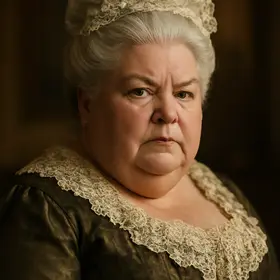
Mrs. Manson Mingott in The Age of Innocence
Major character
The formidable, blunt-minded dowager and matriarch who shelters and defends her scandalized granddaughter, Countess Olenska.
Who is Mrs. Manson Mingott?
Mrs. Manson Mingott is the towering, wealthy matriarch of an old New York clan whose will and purse shield her family from society's strictures. Seated prominently in her ground-floor rooms, she presides over family decisions and social maneuvers with a mixture of shrewd thrift, comic bluntness, and an old-fashioned sense of authority. When Countess Ellen Olenska returns to America as a social embarrassment, Mrs. Mingott immediately takes her in, declines to surrender her to the family's disapproval, and uses her reputation and resources to resist pressure from van der Luyden circles and other arbiters of “Taste.” She arranges for Ellen’s maintenance, insists on her remaining in New York rather than being sent back to Europe, and personally intervenes in family business, even when scandal (such as the Beaufort collapse) threatens to strain loyalties. Her decisive actions force other characters—Newland, the Wellands, and legal advisers—into positions where they must respond to her wishes and to the moral questions the Countess’s presence raises.
In the book: When we first meet Mrs. Manson Mingott, she’s the towering matriarch of old New York—blunt, rich, and very sure of her own judgment. From her ground-floor rooms (stairs aren’t her thing), she decides who’s in or out, and her opinion quickly becomes crucial to how people treat the unconventional Countess Olenska.
Personality
- Formidable
- Chapter IV describes her as a vast, commanding figure whose opinion determines how the Mingotts may defy New York taste.
- Blunt
- In Chapter IV she jokes about the sapphire ring and presses for an early wedding with unceremonious directness.
- Protective
- In Chapter 30 she insists Ellen shall stay with her and be given her allowance rather than be forced back to Europe.
- Practical
- Chapter XI shows her named as the family influence behind the legal consultations about Ellen’s proposed divorce.
- Resilient
- After the Beaufort financial scandal in Chapter 27, she recovers from a stroke and turns attention back to family health and strategy.
Character arc
From her first appearances Mrs. Manson Mingott establishes herself as an emblem of old New York authority: immovable, amusingly frank, and independently wealthy. Early scenes (II, IV) emphasize her ability to override social disapproval by sheer status—the Mingott box at the Opera and her hospitable reception of Ellen show she can set the family’s terms. As the Countess’s crisis deepens, Mrs. Mingott shifts from comic commentator to active protector: she summons and supports legal consultations (XI), refuses to surrender Ellen to family pressure (30), and takes direct charge when scandal and need arise, as with the Beaufort affair that nearly kills her (27). Rather than soften or yield to van der Luyden pressures, she uses her household as refuge and her purse to guarantee Ellen’s independence. By the time Ellen prepares to leave in the farewell scenes, Mrs. Mingott has completed the role she chose—stanch guardian and arbiter—leaving other characters to interpret the moral consequences. Her essential character does not change; she consistently asserts family loyalty and practical charity, even while the world around her debates propriety and reputation.
Relationships
- Countess Ellen Olenska Her granddaughter; she shelters, financially supports, and defends Ellen against family and society's pressure.
- Mrs. Lovell Mingott A member of the Mingott household who sits with Mrs. Manson Mingott in the opera box and shares in family presentation.
- Mr. Lovell Mingott Her son whose family name and legal interests are entwined with her decisions about Ellen's maintenance and the divorce question.
- Newland Archer A prospective son-in-law she summons into family counsel and whom she presses to use his influence on Ellen’s behalf.
- May Welland Her great-niece by marriage whose engagement and wedding Mrs. Mingott attends and whose prospects she teases about.
- Regina Beaufort An outsider whose appeal to the Mingotts during the Beaufort financial crisis provokes Mrs. Mingott’s moral outrage and physical shock.
Quotes by Mrs. Manson Mingott
“You know my niece Countess Olenska?”
IIMrs. Welland introduces her cousin to Archer as he joins the Mingott box to be seen with May.
“Know each other? Fiddlesticks! Everybody in New York has always known everybody.”
IV.Mrs. Mingott dismisses the idea of giving the engaged couple time, arguing New Yorkers already know one another and urging a swift wedding.
“I may catch pneumonia any winter now, and I want to give the wedding-breakfast.”
IV.Mrs. Mingott insists on an early wedding so she can host the wedding-breakfast while she is still able, revealing her blunt practicality and desire for social involvement.
“"I'll go and see Louisa van der Luyden."”
Chapter 6Mrs. Archer's decision to visit Louisa marks the moment when private outrage is converted into mobilized social action.
“I shall first have to talk this over with my husband.”
VII.Her habitual formula of deference that signals joint, ceremonial decision-making and social prudence.
“Honour's always been honour, and honesty honesty, in Manson Mingott's house, and will be till I'm carried out of it feet first,”
Book 2, Chapter 27Mrs. Mingott, newly stricken, asserts the family's uncompromising code of probity in response to Regina Beaufort's plea for the family to cover her husband's disgrace.
Why Mrs. Manson Mingott matters
Mrs. Manson Mingott embodies the power of inherited authority and the pragmatic use of wealth in a society governed by appearance and custom. By sheltering Ellen and insisting on family protection, she exposes the gap between private loyalty and public ‘Taste,’ forcing other characters to confront whether social reputation or humane care should prevail. Her presence also highlights generational contrasts: she acts with a clear, almost comic self-possession that undercuts newer refinements of moral judgment, demonstrating how the old order can both preserve and complicate individual freedom. In short, she is the social bulwark that complicates the novel’s debates about duty, scandal, and personal liberty.
Chapters with Mrs. Manson Mingott
More The Age of Innocence characters
 Newland ArcherProtagonist
 May WellandMajor character
 Countess Ellen OlenskaMajor character
 Mrs. WellandMajor character
 Julius BeaufortMajor character
 Lawrence LeffertsMinor character
 Mr. WellandMinor character
 Mrs. ArcherMajor character
All chapter summaries ›Characters ›
Read The Age of Innocence illustrated
Every scene in these notes comes from the Book2Life reader, where the full public-domain text is illustrated as you read, with character portraits and narration. Free in your browser and on iPhone.
Read The Age of Innocence free
