
M. Krempe in Frankenstein
Minor character
A brusque professor of natural philosophy at Ingolstadt who dismisses alchemy and pushes Victor toward modern science.
Who is M. Krempe?
M. Krempe is Victor Frankenstein’s uncouth professor of natural philosophy at the University of Ingolstadt. He greets Victor’s youthful readings in alchemy with scorn, telling him to abandon those outdated works and begin again with contemporary study. Though coarse in manner, Krempe is competent and corrective: his blunt dismissal forces Victor to reframe his studies and opens a space in which the kinder M. Waldman can kindle Victor’s ambition for modern chemistry. Krempe’s role in the narrative is not as a warm mentor but as a harsh intellectual obstacle whose pragmatism and contempt for the old occult sciences help steer Victor toward the scientific methods and materials that underpin his later experiments. He appears at key moments in Victor’s education and even later provokes unease when Victor hears academic praise, reminding Victor of the path that led to his obsessive research.
In the book: M. Krempe is Victor Frankenstein’s professor of natural philosophy at Ingolstadt. He brusquely dismisses Victor’s early fascination with outdated alchemists and pushes him toward contemporary scientific study, serving as a harsh, corrective force and a foil to the gentler M. Waldman in shaping Victor’s academic path.
Personality
- brusque
- He scorns Victor's early study of alchemists and tells him to discard those books and start anew.
- pragmatic
- He pushes Victor toward contemporary scientific study rather than allowing him to continue with outdated alchemical texts.
- knowledgeable
- Victor finds Krempe knowledgeable despite his off-putting manner while attending lectures at Ingolstadt.
- unsentimental
- Krempe's blunt criticism contrasts with Waldman's humane encouragement and lacks any comforting pedagogy.
Character arc
Krempe’s role is stable rather than dynamic: he first appears as a corrective force when Victor arrives at Ingolstadt and dismisses his alchemical interests, and he stays in that position through Victor’s university years. He does not undergo personal change or deep development in the chapters where he appears; instead, his consistent brusqueness and pragmatic emphasis on modern natural philosophy serve as one of the formative pressures that shape Victor’s intellectual trajectory. Later, the memory of Krempe’s bluntness resurfaces as part of the academic context that troubles Victor during his recovery—Krempe’s critical stance, alongside Waldman’s praise, becomes an emotional trigger for Victor because it recalls the origin and consequences of his scientific pursuit. In short, Krempe remains a steady, corrective presence who pushes Victor away from occult tradition and toward the scientific methods that enable the creation project, but he himself does not evolve within the narrated chapters.
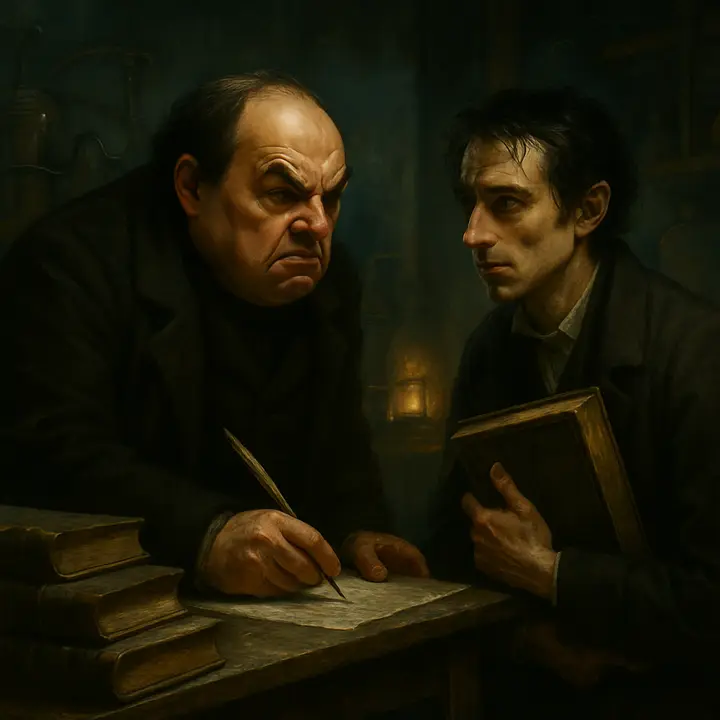
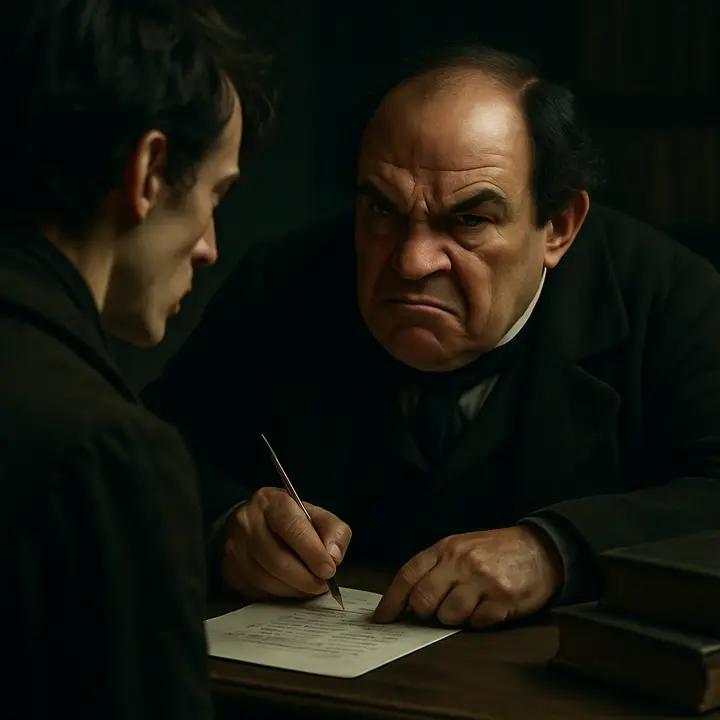
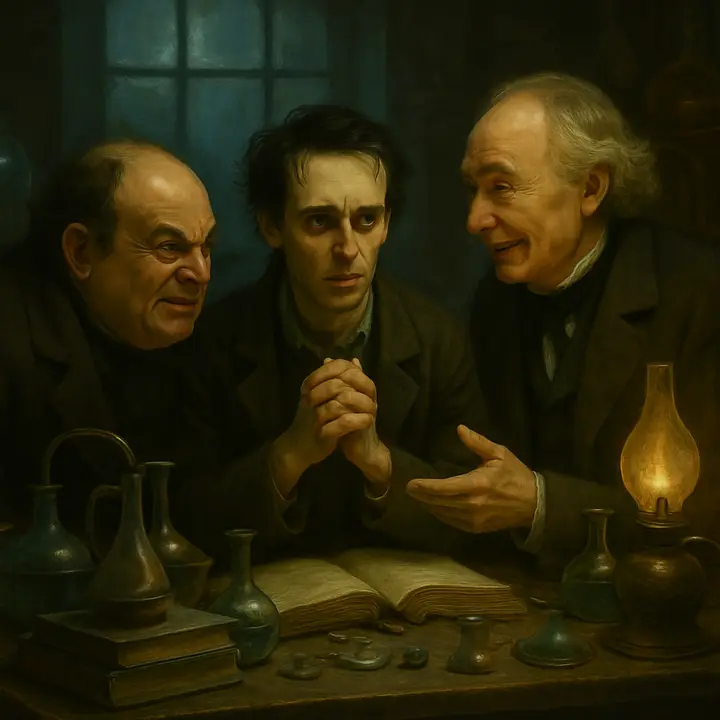
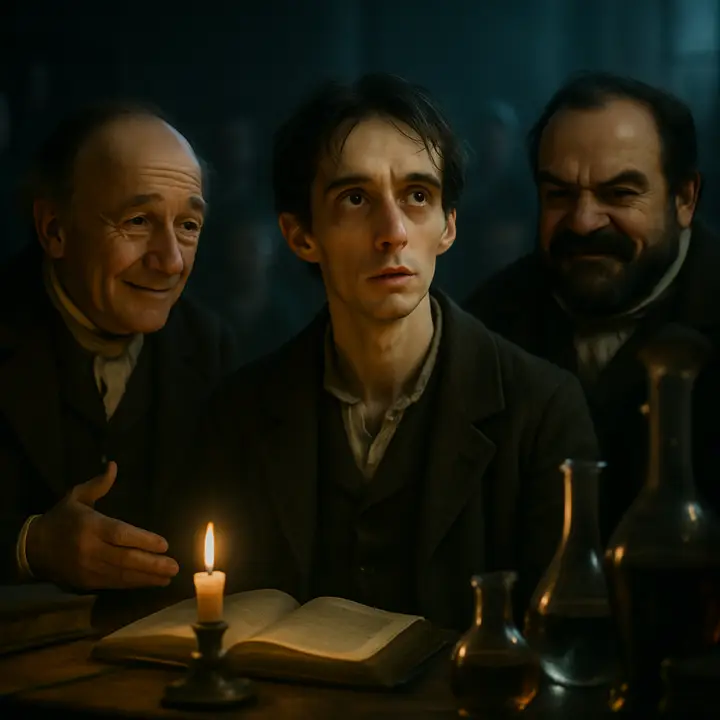
M. Krempe in pictures
Relationships
- Victor Frankenstein Victor’s professor who brusquely criticizes his early alchemical studies and redirects his academic focus.
- M. Waldman A foil and colleague: Krempe’s harsh dismissal of alchemy contrasts with Waldman’s humane encouragement, together shaping Victor’s path.
- Henry Clerval An indirect relation: Krempe’s praise or criticism of scientific work contributes to the academic atmosphere that later unsettles Victor in Clerval’s care.
Quotes by M. Krempe
“"The ancient teachers of this science," said he, "promised impossibilities and performed nothing."”
Chapter 3Waldman's public dismissal of alchemical promises and celebration of modern chemistry frames the scientific shift that influences Victor.
“D—n the fellow!" cried he; "why, M. Clerval, I assure you he has outstript us all.”
Chapter 6Krempe’s coarse praise both angers and unsettles Victor, reviving painful associations with his scientific past.
Why M. Krempe matters
Krempe represents the stern, corrective face of institutional science and the dismissal of older, mystical knowledge. His brusque rejection of alchemy forces Victor to adopt modern scientific methods; that redirection is crucial to the novel’s exploration of scientific ambition, responsibility, and the ethical limits of inquiry. By contrasting with Waldman’s humane mentorship, Krempe helps dramatize competing pedagogies—cold pragmatism versus encouraging guidance—highlighting how different forms of instruction shape a student’s aims and moral bearings.
Chapters with M. Krempe
More Frankenstein characters
 Victor FrankensteinProtagonist
 The CreatureMajor character
 Elizabeth LavenzaMajor character
 Alphonse FrankensteinMajor character
 Henry ClervalMajor character
 William FrankensteinMinor character
 Justine MoritzMinor character
 De LaceyMinor character
All chapter summaries ›Characters ›
Read Frankenstein illustrated
Every scene in these notes comes from the Book2Life reader, where the full public-domain text is illustrated as you read, with character portraits and narration. Free in your browser and on iPhone.
