
Safie in Frankenstein
Minor character
A foreign-born woman who arrives to join the De Lacey household and becomes both pupil and hopeful companion to Felix.
Who is Safie?
Safie is the daughter of a foreign (Turkish) merchant who arrives at the De Lacey cottage and renews the household’s spirits. Determined to escape the social and religious constraints imposed by her father and to live with a Christian husband, she seeks independence and a new life with Felix. Felix teaches her language, literature, and the customs of his family; through these lessons she quickly begins to master words and ideas. Because the Creature watches the household to learn language and human relations, Safie’s lessons directly speed his acquisition of speech, history, and social knowledge. Her arrival therefore functions as a catalyst for the Creature’s intellectual development and for the tensions that follow: the Creature learns to imagine belonging while becoming painfully aware of his own exclusion. Safie embodies cross-cultural encounter, female agency, and the promise of mutual affection, but she also figures in the scene of discovery that precipitates the Creature’s violent rejection and the family’s flight.
In the book: Safie, the daughter of a foreign merchant, joins the De Lacey family and becomes a catalyst for harmony and education in their cottage. As Felix teaches her language and culture, the Creature secretly observes and learns alongside her, making Safie central to his acquisition of speech and understanding of society. Her presence also embodies themes of independence, cross-cultural encounter, and the promise of companionship, deepening the novel’s exploration of what it means to belong.
Personality
- Curious
- She eagerly studies language and books with Felix, learning quickly from Volney’s The Ruins of Empires (Chapter 13).
- Independent
- Refusing to return to her father’s control, she escapes Italy and travels to the De Laceys to avoid the Turkish bondage her mother despised (Chapter 14).
- Hopeful
- Her arrival revives Felix’s spirits and brings joy to the cottage, as she anticipates a new life with a Christian husband (Chapter 13–14).
- Unwitting catalyst
- Her presence and lessons accelerate the Creature’s acquisition of language and social knowledge, deepening his longing and anguish (Chapter 13–15).
Character arc
Safie appears as a figure of restoration and promise: she arrives veiled and welcomed, bringing joy and renewed purpose to the impoverished De Lacey household. Under Felix’s instruction she absorbs language and ideas rapidly, representing the possibility of mutual education and intimate companionship. Because the Creature observes these lessons, Safie indirectly enables his intellectual awakening—allowing him to read history, moral philosophy, and poetry, which intensify his awareness of social exclusion. That amplified knowledge transforms the Creature’s feeling from admiration to bitter longing. When the Creature reveals himself to the blind De Lacey, Safie is among the younger members whose terrified reaction helps transform a sympathetic encounter into a violent rejection; her and the others’ flight ends the brief harmony she helped create. After that episode the narrative no longer follows her; her arc closes as an unrealized promise of belonging and as a pivotal presence whose education both uplifts the household and precipitates the Creature’s downward turn toward rage and revenge.
Safie in pictures
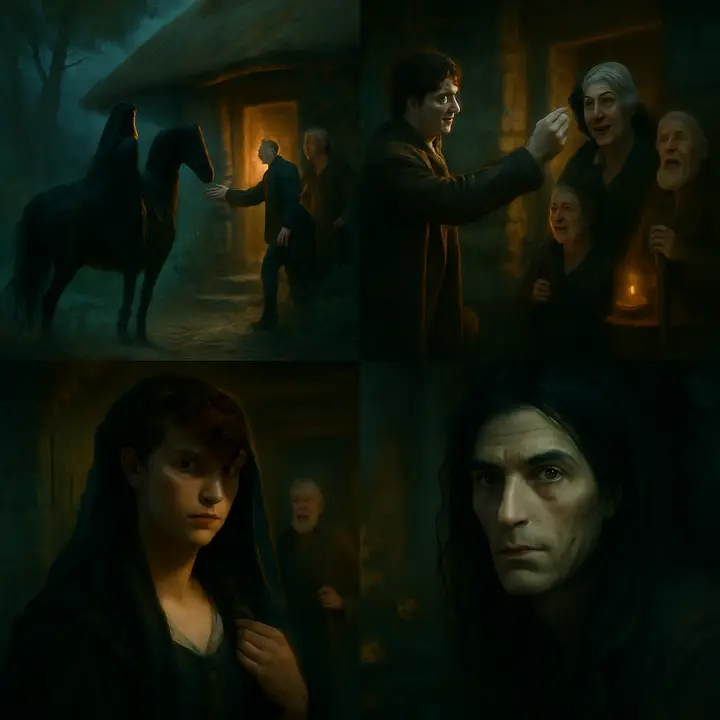


Relationships
- Felix De Lacey Her teacher, beloved, and the Christian whom she hopes to marry; he instructs her in language and European customs.
- De Lacey The blind old man of the household who receives her kindly and whose presence helps make the cottage a refuge for her.
- Agatha De Lacey A younger member of the household who lives with Safie and shares in the family’s everyday life; Agatha reacts with fear when the Creature appears.
- The Creature An unseen observer who learns language and social ideas by watching Safie’s lessons and whose fate becomes entwined with the consequences of her arrival.
- Safie's father A Turkish merchant who betrays Felix’s earlier rescue of his family; his opposition and return to Constantinople motivate Safie’s flight (referred to in the De Lacey history).
Why Safie matters
Safie crystallizes several of the novel’s major themes: education as both enabling and painful, cross-cultural encounter, and the quest for belonging. Her lessons exemplify how language and books open moral imagination—beneficial for the De Laceys and deadly for the Creature, who learns human virtues and vices through her study. Safie’s flight from patriarchal control and her hope for a new social identity highlight themes of autonomy and exile; her eventual role in the family’s rejection of the Creature underscores how fragile sympathy is and how quickly society’s promise of inclusion can dissolve into fear and exclusion.
Chapters with Safie
More Frankenstein characters
 Victor FrankensteinProtagonist
 The CreatureMajor character
 Elizabeth LavenzaMajor character
 Alphonse FrankensteinMajor character
 Henry ClervalMajor character
 William FrankensteinMinor character
 Justine MoritzMinor character
 De LaceyMinor character
All chapter summaries ›Characters ›
Read Frankenstein illustrated
Every scene in these notes comes from the Book2Life reader, where the full public-domain text is illustrated as you read, with character portraits and narration. Free in your browser and on iPhone.
