Noah in Moby-Dick
Minor character
The Pequod’s ship carpenter — a practical, stoic fixer who keeps the vessel and crew functioning.
Who is Noah?
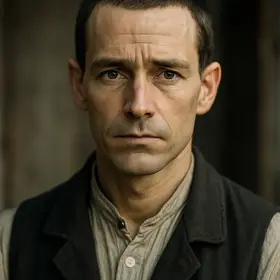
Noah is the Pequod’s carpenter, the indispensable hands-on tradesman who performs the ship’s everyday mechanical miracles. He wants nothing grandiose: his aim is the practical preservation and maintenance of ship and crew, from mending spars and boats to fashioning cages from bone, painting oars, treating sprains, and even extracting teeth. The narrator (Ishmael) single-lines him out amid abstract meditations as an intensely useful presence whose intelligence seems to have migrated into his hands and workshop. Noah works at a heavy vice-bench lashed near the try-works and labors with routined skill and an impersonal stolidity, yet occasional creaks of old humor and a grizzled wit surface, giving hints of an inner life. He is not a leader or a theorist but the quietly essential operator whose competence underwrites the voyage’s daily survival.
Personality
- Practical
- He repairs boats and spars, fashions cages from whale-bone, paints oars, and treats sprains at his vice-bench.
- Stolid
- The narrator emphasizes his impersonal stolidity, as if his inward life is minimal compared with his mechanical skill.
- Resourceful
- He performs a wide range of tasks—drilling ears, extracting teeth, resizing belaying pins—showing versatile craftsmanship.
- Wry
- Alongside his blank steadiness, occasional flashes of old, creaking humor and a grizzled wit appear in his demeanor.
- Indispensable
- The narrator singles him out as the practical indispensability amid abstract human types aboard the Pequod.
Character arc
Noah’s trajectory through the narrative is not dramatic but steady: he appears and remains the practical center of material labor. From his first fuller appearance at the vice-bench near the try-works, he is shown doing the many routine repairs and odd jobs that keep ship and men afloat. Rather than undergoing transformation, Noah deepens as a presence: the more the narrator muses on abstract or cosmic subjects, the more Noah’s concrete usefulness is emphasized. Any suggestion of interiority appears only in brief, creaking flashes of humor; otherwise he persists as a mechanical intelligence embodied in tools and hands. By the time the ship moves on through the whale grounds and the narrator contemplates broad questions of magnitude and survival, Noah’s role remains the same—quietly sustaining life aboard through skill and steady labor—offering an anchor of human craft against the novel’s larger meditations on the sea and species endurance.
Relationships
- Ishmael Observed and described by Ishmael, who singles him out as the ship’s practical indispensability.
- Narrator Functions as the object of the narrator’s extended reflection on craftsmanship and human types at sea.
- Pequod Serves the Pequod as its chief repairman and maintainer of equipment essential to the voyage.
- Crew Provides practical services—repairs, medical fixes, and odd jobs—to the ship’s crew, enabling their daily work.
- Try-works Works at a heavy vice-bench lashed opposite the try-works, making that spot the locus of his labors.
- Captain Ahab Indirectly serves Ahab by keeping the ship operational, though he is not portrayed as involved in Ahab’s obsessions.
Why Noah matters
Noah embodies the novel’s attention to ordinary human labor amid cosmic and philosophical concerns. As a figure of craft and repair he contrasts with Ahab’s monomaniacal will and the narrator’s abstract meditations, grounding the Pequod in material necessity. His stolidity and resourcefulness illustrate themes of interdependence, the practical intelligence of hands, and the quiet heroism of survival work. In a book obsessed with enormities—whales, fate, and obsession—Noah represents human-scale competence and the sustaining, unglamorous labors that let men continue to face the inscrutable sea.
Chapters with Noah
More Moby-Dick characters
 Ahab
Ahab Ishmael
 Stubb
Stubb Queequeg
 Starbuck
 Flask
Flask Tashtego
 Moby Dick
All chapter summaries ›Characters ›
Read Moby-Dick illustrated
Every scene in these notes comes from the Book2Life reader, where the full public-domain text is illustrated as you read, with character portraits and narration. Free in your browser and on iPhone.
