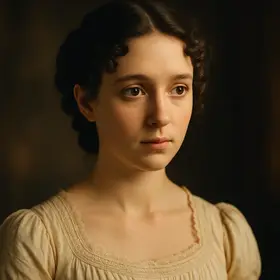
Maria Lucas in Pride and Prejudice
Minor character
Sir William Lucas’s daughter who accompanies Elizabeth to Hunsford and Rosings, a polite but unremarkable member of the local gentry.
Who is Maria Lucas?
Maria Lucas is the daughter of Sir William and Lady Lucas and a frequent companion to Elizabeth Bennet during Elizabeth’s visit to Hunsford and the subsequent calls at Rosings and the Gardiners. She travels with Elizabeth from Longbourn, taking part in the dull, polite conversation that highlights Elizabeth’s relief at leaving home life (Ch.27). At Rosings she forms part of the awed visiting party who endure Lady Catherine’s lectures (Ch.29). Maria walks regularly to the parsonage with Charlotte and Elizabeth and helps sustain the pattern of social visits that bring Darcy into closer, if often awkward, contact with Elizabeth (Ch.32). She shares the return journey with Elizabeth to the Gardiners and is present in the domestic bustle at Longbourn, contributing to the social texture of the Bennet household (Ch.38–39). Maria remains a steady, unobtrusive presence whose conventional behavior contrasts with more striking personalities around her.
Personality
- Polite
- She accompanies Elizabeth in civil, composed company to Hunsford and Rosings, taking part in the formal calls and farewells (Ch.27, Ch.29).
- Unremarkable
- Her conversation on the journey to Hunsford is described as dull, underscoring her lack of striking individuality (Ch.27).
- Obliging
- She boards the chaise with Elizabeth and follows Mr. Collins’s insistence to pay respects at Rosings before departure (Ch.38).
- Sociable
- She regularly walks to the parsonage with Charlotte and visits the Collins household, helping sustain neighborhood social calls (Ch.32).
Character arc
Maria’s role remains largely steady from her first appearance to her last: she is introduced as Sir William Lucas’s polite daughter and continues to function as a conventional companion and escort for Elizabeth. Her early presence emphasizes the tedious civility of provincial visits (Ch.27), and at Rosings she participates in the awe and nervous admiration of Lady Catherine’s party (Ch.29). As Elizabeth becomes more embroiled in the parsonage’s social world, Maria’s regular walking visits help create the circumstances for Darcy’s visits and the awkward tête-à-têtes that follow (Ch.32). She accompanies Elizabeth on the return journey to the Gardiners and joins domestic scenes at Longbourn (Ch.38–39). Throughout the narrative Maria changes little in temperament or station: she remains a courteous, conventional young woman whose steady sociability supports others’ developments rather than undergoing notable personal transformation.
Relationships
- Sir William Lucas Her father, a local gentleman whose admiration for Bingley helps seed the social interest in Netherfield (Ch.3, Ch.27).
- Lady Lucas Her mother, who supplies local reports and social perspective that the Bennets rely on (Ch.3).
- Charlotte Lucas A close family friend whose marriage to Mr. Collins brings Maria into the circle visiting Hunsford and Rosings (Ch.27–29).
- Elizabeth Bennet A traveling companion and conversational foil; Maria accompanies Elizabeth to Hunsford and shares the return journey (Ch.27, Ch.38).
- Mr. Collins The parson whose officious rituals Maria endures as part of the visiting party and whose deference to Lady Catherine frames several calls (Ch.28–29, Ch.38).
Quotes by Maria Lucas
“Oh, my dear Eliza! pray make haste and come into the dining-room, for there is such a sight to be seen!”
Chapter 28Maria’s breathless summons signals the arrival of visitors at the gate and builds curiosity that reveals expectations about Rosings’ importance.
Why Maria Lucas matters
Maria functions as a social texture-figure: her conventional politeness and unremarkable conversation emphasize the normal, decorous world from which more dramatic personalities diverge. By accompanying Elizabeth to Hunsford and Rosings she helps create situations in which Elizabeth observes and judges figures like Lady Catherine and Darcy; Maria’s steadiness and conventionality highlight Elizabeth’s livelier irony and critical faculties. In short, Maria embodies provincial civility and the everyday social ties that sustain and expose the novel’s central conflicts about class, marriage, and comportment.
Chapters with Maria Lucas
More Pride and Prejudice characters
 Elizabeth BennetProtagonist
 Jane BennetMajor character
 Mr. BingleyMajor character
 Mr. DarcyMajor character
 Mrs. BennetMajor character
 Mr. BennetMajor character
 Lydia BennetMinor character
 Mr. CollinsMajor character
All chapter summaries ›Characters ›
Read Pride and Prejudice illustrated
Every scene in these notes comes from the Book2Life reader, where the full public-domain text is illustrated as you read, with character portraits and narration. Free in your browser and on iPhone.
