Leviathan in Moby-Dick
Major character
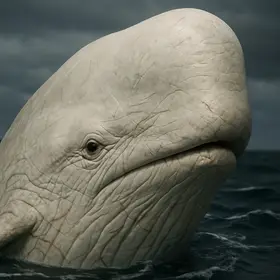
The archetypal whale — vast, ancient, and sublime, invoked as Leviathan across myth, scripture, and natural history.
Who is Leviathan?
Leviathan is the book’s collective monstrous whale figure assembled from scripture, classical myth, natural history, and sailors’ testimony. The narrator treats Leviathan as both a real cetacean and a cultural symbol: a creature of prodigious size and power that inspires religious awe, heroic rivalry, commercial exploitation, and scientific curiosity. Across the extracts the Leviathan appears as scriptural great whale, in Chapter 82 as the mythic adversary of Perseus, St. George, Jonah, and Vishnu (thus legitimizing the whaleman’s heroic status), in Chapter 86 as a living anatomical marvel—especially in its tail’s strength and grace—and in Chapter 104 as a fossilized ruler of primeval epochs. Leviathan wants nothing (it is an animal and an idea); humans want to know, conquer, worship, profit from, and narrate it. The narrator examines and catalogues the Leviathan’s physicality, cultural meanings, and antiquity, positioning the creature as the central object that summons both encyclopedic language and moral, aesthetic reflection.
Personality
- Ancient
- Chapter 104 cites widespread fossil finds and primeval reconstructions to argue that the Leviathan’s lineage dwarfs human antiquity.
- Sublime
- In the Extracts and Chapter 82 the narrator quotes scripture and myth (e.g., ‘And God created great whales’) to emphasize the creature’s awe-inspiring magnitude.
- Ambiguous
- Chapter 86 ends by admitting that despite anatomical scrutiny the whale’s face and true nature remain inscrutable.
- Formidable
- Chapter 86 analyzes the tail’s layered power and lists motions (recoil blows, lobtailing) that make the whale a deadly opponent to boats.
- Iconic
- Chapter 82 enshrines the Leviathan within a fellowship of heroes and gods, making the whale a cultural and religious emblem.
Character arc
Leviathan’s ‘story’ within these chapters is not a personal development but a progressive deepening of human responses to it. In the Extracts Leviathan appears as a collage of voices—scriptural, scientific, poetic—that already frame it as vast and multifaceted. Chapter 82 moves from that collage to mythic elevation, naming Leviathan a rightful object of heroic combat and religious precedent, thereby sacralizing the whaleman’s craft. Chapter 86 shifts attention to corporeal detail, anatomizing the tail and revealing how brute physicality and elegant motion coexist; here Leviathan functions as a living, technical subject whose movements threaten and mesmerize sailors. Finally Chapter 104 historicizes the creature, showing it as fossil evidence of ancient epochs and prompting grand, imaginative reconstructions of pre-human worlds. Across these treatments the Leviathan itself does not change; rather human discourse about it accrues layers—mythic honor, anatomical study, and geological antiquity—so that the whale becomes ever more boundless and resistant to full comprehension.
Relationships
- Narrator The Narrator (Ishmael) is Leviathan’s principal chronicler, compiling scripture, natural history, myth, and personal reflection to render the creature’s manifold meanings.
- Jonah Jonah is evoked in Chapter 82 alongside Leviathan to link biblical sea-monster tradition with whaling’s symbolic history.
- Moby Dick Moby Dick stands as a particular instance of the broader Leviathan idea—the individual whale that will embody the same enormity and menace the narrator attributes to Leviathan.
- Pequod The ship Pequod represents the whaleman community whose vocation and honor are defined in relation to Leviathan as quarry, adversary, and object of reverence.
- Perseus Mentioned in Chapter 82 as a heroic whaleman who harpooned Leviathan to save Andromeda, linking classical heroics to the whale’s mythic status.
- Vishnoo Invoked in Chapter 82 as a deity who incarnates as a whale to recover sacred texts, thereby sacralizing the Leviathan across cultures.
Why Leviathan matters
Leviathan functions as the central symbol through which Melville explores the sublime, the limits of human knowledge, and the mingled impulses to worship, exploit, and conquer nature. As a creature both anatomically formidable and mythically charged, Leviathan exposes tensions between scientific inquiry and religious awe, between industry (oil, commerce) and reverence. Its fossil presence in Chapter 104 stretches human time, challenging anthropocentric narratives and insisting on a deep, indifferent natural history. In short, Leviathan is the book’s focal point for meditations on scale, mystery, and the moral stakes of humanity’s encounter with the sea.
Chapters with Leviathan
More Moby-Dick characters
 Ahab
Ahab Ishmael
 Stubb
Stubb Queequeg
 Starbuck
 Flask
Flask Tashtego
 Moby Dick
All chapter summaries ›Characters ›
Read Moby-Dick illustrated
Every scene in these notes comes from the Book2Life reader, where the full public-domain text is illustrated as you read, with character portraits and narration. Free in your browser and on iPhone.
