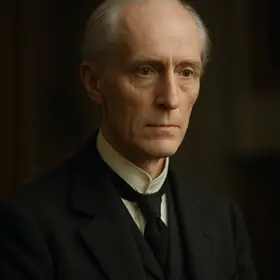
Henry van der Luyden in The Age of Innocence
Major character
The dignified, quietly powerful head of the van der Luyden family who embodies Old New York's authority and social judgment.
Who is Henry van der Luyden?
Henry van der Luyden is the reserve and arbiter at the apex of New York's old aristocracy. Living in formal seclusion with his wife, he personifies the city’s highest polite authority: his calm assent or disapproval settles delicate social questions. When the Mingotts invite Countess Olenska back into society and most households snub the invitation, Mrs. Archer seeks the van der Luydens' influence; Henry's presence and solemn dignity are treated as decisive. He hosts the grand van der Luyden dinner where Ellen’s entrance and composure are observed; he also makes a point of 'warning' the Countess about certain associations, presenting himself as a guardian of propriety. At smaller dinners he presides with the same measured gravity, creating the setting in which rumors, judgments, and the city’s etiquette play out. He moves little, speaks little, but his interventions and the weight given to them shape how other characters act and how society responds to scandal.
In the book: When we first meet Henry van der Luyden, he’s the quietly powerful head of New York’s most revered old-family household, living in rarefied seclusion with his wife. People come to him when they need the ultimate social verdict, and his calm endorsement can settle a brewing society dilemma—like whether Countess Olenska should be publicly welcomed.
Personality
- Reserved
- He lives in 'rarefied seclusion' and speaks with solemnity, offering calm endorsements rather than loud pronouncements.
- Authoritative
- People come to him when they need the ultimate social verdict, and his endorsement can settle a brewing dilemma about the Countess.
- Conservative
- He 'warns' the Countess about her associations, acting to uphold New York etiquette and family reputation.
- Ceremonial
- He presides over grand dinners and formal entertainments—settings that emphasize old-fashioned splendor and social order.
- Patronizing
- His intervention with the Countess is framed as guidance from a superior social position, implying she needs correction.
Character arc
Henry van der Luyden remains essentially the same from his first appearance to his last: a steady, dignified emblem of entrenched social authority. He is introduced as the culminating point of the city's social pyramid whose calm judgment can restore or deny acceptance. Across the scenes in which he appears he repeatedly exercises that role—hosting formal dinners that display the family's old-fashioned splendor, offering a solemn 'warning' to the Countess about improprieties, and presiding over gatherings where gossip and etiquette are adjudicated. He does not undergo personal transformation or crisis; instead, his constancy functions as a social force against which other characters—especially Newland and the Countess—measure their doubts and passions. By remaining immovable, he keeps the expectations and restraints of Old New York intact, steering events through the quiet leverage of inherited prestige rather than through dramatic action or revelation.
Relationships
- Louisa van der Luyden His wife and partner in maintaining the household’s social supremacy and ceremonial life.
- Countess Ellen Olenska A relative and the subject of his moral admonitions; he 'warns' her about associations that threaten family reputation.
- Mrs. Archer A supplicant who seeks the van der Luydens' influence to help secure the Countess's social reception.
- Newland Archer A guest and observer at van der Luyden events whose impressions are shaped by Henry’s solemn authority.
- Mr. Sillerton Jackson A fellow member of polite society who participates in the formal dinners Henry hosts and whose historical allusions complement the van der Luydens' decorum.
- May Welland An emblem of the 'nice' society Henry protects; she appears within the social order he helps enforce.
Why Henry van der Luyden matters
Henry van der Luyden functions as the human embodiment of Old New York’s conservative social code. His quiet authority and ritualized interventions crystallize the novel’s concerns with reputation, conformity, and the weight of inherited power. By mediating acceptance and disapproval through measured formality, he exposes how manners and ceremony enforce limits on individual choice—particularly for women like the Countess and for men like Newland, whose private desires conflict with public expectation. His steadiness underscores the difficulty of escaping social destiny and highlights the novel’s critique of a society that values preservation of surface order above emotional truth.
Chapters with Henry van der Luyden
More The Age of Innocence characters
 Newland ArcherProtagonist
 May WellandMajor character
 Countess Ellen OlenskaMajor character
 Mrs. Manson MingottMajor character
 Mrs. WellandMajor character
 Julius BeaufortMajor character
 Lawrence LeffertsMinor character
 Mr. WellandMinor character
All chapter summaries ›Characters ›
Read The Age of Innocence illustrated
Every scene in these notes comes from the Book2Life reader, where the full public-domain text is illustrated as you read, with character portraits and narration. Free in your browser and on iPhone.
Read The Age of Innocence free
