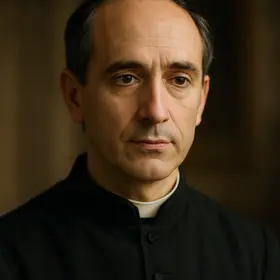
The Priest in Don Quixote
Major character
Don Quixote’s sensible friend and moral compass who moderates his madness and organizes plans to cure him.
Who is The Priest?
The Priest (the curate) is a local clergyman and close friend of Don Quixote who acts as the voice of common sense and social order. Alarmed by the knight’s obsession with chivalric books, he helps the barber inspect and destroy many volumes, and repeatedly participates in schemes to bring Quixote home safely. He organizes disguises and rehearsed stories (the Micomicona ruse), mediates quarrels among the party, offers shelter to wronged figures like Dorotea, and defends prudent judgments in disputes about literature and conduct. Though critical of romances, he reads and judges novels aloud when curiosity and company require it. The Priest balances charity and firmness: he counsels Don Quixote, negotiates with authorities (the Holy Brotherhood and a canon), and assists in the final pastoral retreat that precedes Quixote’s death. Throughout, he aims to restore social and moral equilibrium without trampling the compassion owed to his friend or to the suffering people they encounter.
In the book: The Priest (the curate) is Don Quixote’s sensible friend and moral compass, representing social order and orthodox values. He helps assess the chivalric books that influence Don Quixote, works with the barber to protect him from further misadventures, and frequently mediates between idealism and practicality, grounding the story’s comic and critical reflections on literature and society without overshadowing the protagonist.
Personality
- Practical
- He devises and executes the disguise-and-rescue plans with the barber to bring Don Quixote home (Chapters 27–29).
- Judicious
- He condemns books of chivalry publicly at the inn and later reads and judges a novel aloud to decide its merit (Chapters 32, 36).
- Compassionate
- He shelters Dorotea and Cardenio, listens to their stories in the mountains, and helps arrange their reunions (Chapters 28–36).
- Authoritative
- He persuades the officers of the Holy Brotherhood to leave Don Quixote alone by arguing the knight is mad, defusing a potential arrest (Chapter 46).
- Mediator
- He mediates disputes at the inn, helps settle accounts, and negotiates reconciliations among the party (Chapters 36, 46).
Character arc
From his earliest visits the Priest occupies the role of careful observer and corrective influence: he keeps distance for a month to avoid enabling Quixote’s delusions (Chapter 1), then probes the knight’s mind and convenes with the barber and Samson to limit harm. Faced with continued episodes of madness, he moves from private admonition to active intervention—planning disguises, coordinating the Micomicona plot, and taking part in theatrical deceits designed to steer Quixote toward recovery (Chapters 27–31). As complications arise, he balances skepticism about romances with charitable attention to real sufferers, listening to Dorotea and Cardenio and supporting their restitution (Chapters 28–36). When public order threatens (Holy Brotherhood, legal claims), he speaks with authority to defuse conflict and protect Quixote from coercive punishment (Chapters 46–47). In the final sequence he accompanies Don Quixote back to La Mancha, helps nurse him during his fever, witnesses the knight’s renunciation of chivalric books, and acts as executor of his will—shifting from clinician and plotter to pastoral caregiver who sees Quixote peacefully restored to reason before death (Chapters 52, 73–74). Throughout, he refuses romanticizing extremes and steadily reasserts orthodox social values while exercising mercy.
The Priest in pictures


Relationships
- Don Quixote Friend and moral guardian who tries to cure him of chivalric madness and later cares for him in illness.
- The Barber Co-conspirator and practical partner in plans to manage and restore Don Quixote, including book-burning and disguises.
- Sancho Panza Interlocutor whose common-sense reports and comic practicality the Priest listens to and sometimes counsels.
- Dorotea A victim he shelters and to whose invented princess role he gives support in order to channel Don Quixote’s delusions into a cure.
- Cardenio A broken gentleman whose tale the Priest hears and to whom he offers refuge and practical assistance.
- Samson Carrasco Fellow friend and collaborator who joins the Priest in schemes to restrain and rehabilitate Don Quixote.
Quotes by The Priest
“this morning that famous student-shepherd called Chrysostom died, and it is rumoured that he died of love for that devil of a village girl the daughter of Guillermo the Rich, she that wanders about the wolds here in the dress of a shepherdess.”
Chapter 12Opening announcement that sets the chapter in motion: Chrysostom's death and its alleged cause (love for Marcela).
“I cannot understand how that can be, for in truth to my mind there is no better reading in the world, and I have here two or three of them, with other writings that are the very life, not only of myself but of plenty more;”
Chapter 32The innkeeper defends books of chivalry as beloved entertainment for his workers and customers.
“We want my friend’s housekeeper and niece here now.”
Chapter 32The barber jokes about needing female accomplices to act out parts from their stratagems, highlighting the theatricality of their plot.
“Well then, attend to me everyone, for the novel begins thus.”
Chapter 32After finding a manuscript titled “Novel of the Ill-advised Curiosity,” the curate prepares to read it aloud to the assembled company, initiating a story-within-the-story.
“If your worships will give me your attention you will hear a true story which, perhaps, fictitious ones constructed with ingenious and studied art cannot come up to.”
Chapter 38The captive promises to tell his life-story after supper, setting up a new narrative thread and capturing the listeners’ rapt attention.
Why The Priest matters
The Priest embodies the novel’s ethic of moderation: skeptical of dangerous fictions yet compassionate toward human frailty. He represents institutional reason—church, community, and common sense—that contests the destabilizing effects of chivalric fantasia. By organizing corrective theatrical strategies, mediating disputes, and ultimately tending Don Quixote in death, he shows that restoration of social order relies on prudent intervention, not merely punishment. His presence frames Cervantes’s critique of books, balancing satire with charity and emphasizing responsible stewardship of friends and community.
Chapters with The Priest
More Don Quixote characters
 Don QuixoteProtagonist
 Sancho PanzaMajor character
 Dulcinea del TobosoMinor character
- RRocinanteMajor character
 The DukeMajor character
- DDappleMinor character
 The BarberMajor character
 Cide Hamete BenengeliNarrator
All chapter summaries ›Characters ›
Read Don Quixote illustrated
Every scene in these notes comes from the Book2Life reader, where the full public-domain text is illustrated as you read, with character portraits and narration. Free in your browser and on iPhone.
