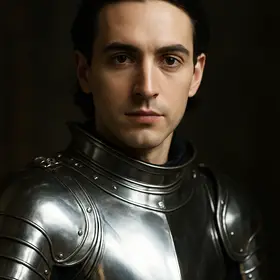
Samson Carrasco in Don Quixote
Major character
A learned bachelor and neighbor who devises witty ruses to cure Don Quixote and steer him back to ordinary life.
Who is Samson Carrasco?
Samson Carrasco is a university-educated bachelor and neighbor, called “the Bachelor,” who admires Don Quixote but believes his madness must be checked. He appears early to debate the worth of chivalric tales, question the printed history of Don Quixote’s adventures, and parry Sancho’s blunt common sense. Concluding that the safest remedy is trickery rather than force, Samson takes on knightly disguises—first as the Knight of the Mirrors—to confront and unseat Don Quixote and bind him, by the terms of a knightly defeat, to return home for a year. After an initial failure that leaves him bruised, he persists, obtains treatment for his wounds, and ultimately succeeds in besting Don Quixote (revealed later), a victory that precipitates Don Quixote’s enforced retirement. Samson remains a practical, educated presence at Don Quixote’s side as the knight contemplates shepherd life, helps compose pastoral conceits, and stands by during the failed recovery; Don Quixote names him an executor in his will before dying. Throughout, Samson balances friendship, skepticism, and the desire to restore social order without cruelty.
In the book: A bright university-trained neighbor known as “the Bachelor,” Samson Carrasco is both admirer and critic of Don Quixote. He serves as a clever foil who uses wit, learning, and elaborate ruses to test, challenge, and ultimately try to steer Don Quixote back toward ordinary life, making him central to the novel’s exploration of sanity, idealism, and social reality without overshadowing the hero.
Personality
- learned
- He argues about history and poetic license with Don Quixote, citing historians versus poets while discussing the circulating book (Chapters 2–4).
- witty
- He greets Don Quixote with mock homage and parries jests with learned banter when summoned to dissuade the third sally (Chapter 7).
- practical
- He counsels prudence—urging travel to Saragossa for the jousts—and later contrives a plan to force Don Quixote home by disguised combat (Chapters 4, 15).
- determined
- After his first disguised attempt leaves him beaten, he seeks a bone-setter and resolves to try again until he succeeds in compelling Quixote’s retreat (Chapter 15; Chapter 65).
- compassionate (measured)
- Although he aims to stop Don Quixote, he treats him respectfully in debate and accepts Don Quixote’s pastoral plans, later serving as an executor of his will (Chapters 3, 74).
Character arc
Samson begins as a skeptical, learned neighbor who both admires and questions Don Quixote’s chivalric convictions. Early scenes show him debating the nature of printed histories and humorously testing Don Quixote’s claims, positioning himself as an interlocutor rather than a tyrant (Chapters 2–4). Concluding that argument alone will not cure his friend, he adopts an active strategy: he disguises himself as a knight to confront Don Quixote and bind him by the conventions of knightly honor to abandon roaming. The first attempt (the Knight of the Mirrors) fails and leaves Samson physically bruised and humiliated, yet he treats the setback pragmatically—finding medical care and planning anew (Chapters 14–16). Ultimately Samson succeeds in a later encounter (revealed in Chapter 65) and fulfills the agreed purpose: he forces Don Quixote to accept a year’s retirement. In Don Quixote’s final days Samson is present, helping oversee the knight’s pastoral conceits and is named an executor of his will, moving from active trickster to respectful guardian at the moment of Alonso Quixano’s lucid death (Chapters 67, 74). His arc is less about being changed than about steadily applying learning and resourcefulness to restore social equilibrium.
Samson Carrasco in pictures


Relationships
- Don Quixote Friend, foil, and the primary object of Samson’s schemes to restore him to ordinary life; he both debates and deceives Quixote for his good.
- Sancho Panza Sancho’s plainspoken squire and occasional interlocutor; Samson listens to Sancho’s reports and shares in the comic exchanges about promises and governance.
- The Priest Collaborator in plans to cure Don Quixote; Samson consults and coordinates with the curate over how to handle the knight.
- The Barber Co-conspirator and companion who aids Samson’s schemes and shares in the household efforts to moderate Don Quixote.
- The Duke An amused patron of the entertainments surrounding Don Quixote; Samson informs the duke of the knight’s route and participates in interactions at the duke’s house.
- The Duchess Member of the aristocratic circle that stages jests and theatrical games in which Samson takes part while managing Don Quixote’s behavior.
Quotes by Samson Carrasco
“Let me kiss your mightiness’s hand, Señor Don Quixote of La Mancha, for, by the habit of St. Peter that I wear, though I have no more than the first four orders, your worship is one of the most famous knights-errant that have ever been, or will be, all the world over.”
Chapter 3Samson adopts mock-solemn flattery on arrival, both praising and gently ridiculing Don Quixote to set a jocular tone.
“There is no book so bad but it has something good in it,”
Chapter 3Carrasco defends the merits of printed works and moderates the criticism of authors and their faults.
“The difference between the two sorts of madmen is, that he who is so will he nil he, will be one always, while he who is so of his own accord can leave off being one whenever he likes.”
Chapter 15Samson’s pragmatic distinction between inevitable madness and voluntary folly, justifying his plan to ‘cure’ Don Quixote.
“I know very well, señor, what you have come for; it is to find out who I am; and as there is no reason why I should conceal it from you, while my servant here is taking off my armour I will tell you the true state of the case, without leaving out anything.”
Chapter 65Carrasco reveals himself as the Knight of the White Moon and explains his motives and earlier disguise.
Why Samson Carrasco matters
Samson Carrasco embodies the educated, rational counterforce to Don Quixote’s idealistic madness. He demonstrates that learning and wit can be used compassionately to correct folly without cruelty: his disguises and debates test the limits of honor, identity, and social responsibility. By using the conventions of chivalry against Don Quixote—defeating him in a formally knightly way—Samson exposes how social forms can restore order while highlighting the novel’s interest in fiction’s power to shape behavior. His actions focus the book’s themes of sanity versus illusion, the social effects of literary culture, and the tension between sympathy and social duty.
Chapters with Samson Carrasco
More Don Quixote characters
 Don QuixoteProtagonist
 Sancho PanzaMajor character
 Dulcinea del TobosoMinor character
- RRocinanteMajor character
 The DukeMajor character
- DDappleMinor character
 The BarberMajor character
 Cide Hamete BenengeliNarrator
All chapter summaries ›Characters ›
Read Don Quixote illustrated
Every scene in these notes comes from the Book2Life reader, where the full public-domain text is illustrated as you read, with character portraits and narration. Free in your browser and on iPhone.
